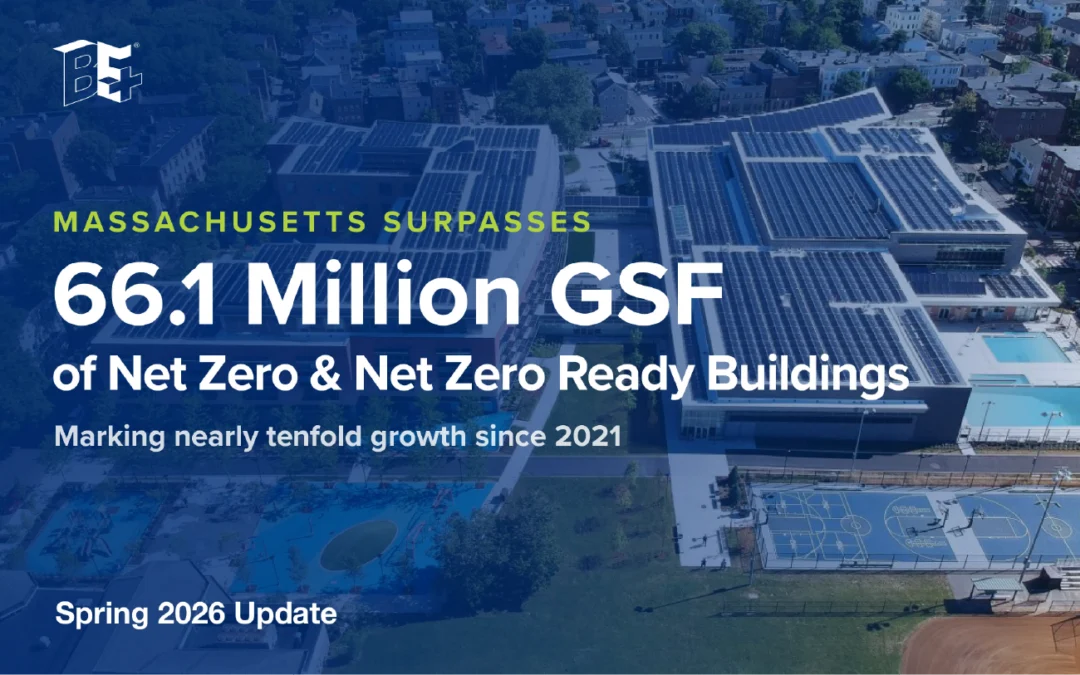
Massachusetts continues to demonstrate strong and consistent growth in high-performance building development, according to our new statewide report, Massachusetts is Going Net Zero: Spring 2026 Update.
From Cost Concerns to Market Transformation
We started this research in 2021 by collecting real project data to demonstrate that despite a strong narrative about cost fears, there was little to no cost premium for net zero energy buildings. Since tracking began in 2021, documented Net Zero and Net Zero Ready building stock in Massachusetts has grown from 7.2 million GSF to 66.1 million GSF, with an increase of 17.7 million GSF since 2024 alone and a nearly tenfold expansion in just five years. This data doesn’t even capture single family homes or multifamily residential buildings under 15k GSF or 15 units. Of the 19.3 million GSF with reported cost data, 71% reported <1% construction cost premium to achieve Net Zero Ready.
“At a time when energy prices are soaring from political instability, it’s more important than ever that we invest in highly efficient buildings that cut out fossil fuels and rely on renewable, low-carbon sources,” said Meredith Elbaum, Executive Director of Built Environment Plus. “Fortunately Massachusetts has had the foresight and leadership to embrace high performance buildings, with improving standards, forward-thinking energy codes, and extensive investment in clean energy infrastructure, a thriving climate tech ecosystem, and vital support through incentives. We should be doubling down, not taking our foot off the pedal.”
Massachusetts Is No Longer in the Early-Adopter Phase
The data collection for the report happened exclusively through Built Environment Connects, a dynamic discovery tool bridging the people, companies, and high-performance buildings represented in this report. With over 500 projects, 220 professionals, and 200 companies, the report concludes that Massachusetts has moved beyond early adoption and is now firmly in a phase of large-scale implementation.
Key findings from the report include:
• The Net Zero and Net Zero Ready building stock exceeds 66.1 million GSF, across 500+ projects, and continues to expand.
• Multi-family and affordable housing’s combined 20.9 million GSF are leading the way for Net Zero development in Massachusetts
• Lab/Tech/Science grew by 20% since 2024 up to 16.5 million GSF, making up the majority of the found Net Zero Ready space
• Of the 19.3 million GSF with reported cost data, 71% reported <1% construction cost premium to achieve Net Zero Ready.
• Adoption of heat pump technology across all building types
• Since 2024, nearly twice as many projects have reported being all-electric for domestic hot water, totaling 39.7 million GSF.
The Policies Behind the Progress
The report attributes much of this momentum to Massachusetts’ strong combination of climate policy, utility programs, and market adoption strategies that continue to lower operational costs and support electrification at scale. The majority of this data was shared before the adoption of the current Massachusetts Energy Code. In municipalities that have adopted the current Stretch and Specialized Energy Codes, Net Zero Ready is the new baseline, effectively eliminating the existence of a cost premium. In 2024, we added an option, “We didn’t calculate the cost premium.” Of the projects that did not calculate cost, over half said Net Zero was necessitated by code or client preference.
The Impact of Energy Efficiency Programs
Programs such as Mass Save have played a critical role in reducing energy demand, improving building performance, and helping projects transition away from fossil fuels cost-effectively. These incentives generate $3.50 in energy cost savings for every $1 invested and they have created the new standard for building. However, industry leaders caution that this progress could slow if proposed cuts to Mass Save move forward.
“It would disrupt planned investments, strand ongoing projects, and break commitments to households and businesses that have already begun upgrades,” said the Alliance for Climate Transition.
Experts warn that weakening Massachusetts’ nationally recognized energy efficiency infrastructure could increase energy costs, reduce demand-side efficiency gains, and disrupt the growing pipeline of electrification projects that are driving the Commonwealth’s Net Zero transition.
What’s Next?
As Massachusetts continues to scale high-performance building development, the report makes it clear that Net Zero is no longer a niche market, but it is rapidly becoming the standard for new construction and major renovations across the Commonwealth. At the same time, we are helping building owners tackle the decarbonization of their existing buildings through a new program, the Building Performance Exchange, in partnership with the Mass Clean Energy Center. By taking on new construction and existing buildings together, Massachusetts can ensure that high performance buildings are the norm rather than the exception.