Support BE+ through 1% for the Planet

Support BE+ through 1% for the Planet

Built Environment Plus (BE+) is proud to announce that we have been accepted as an official environmental partner of 1% for the Planet, joining a global network of organizations working to create a healthier, more resilient future.

For nearly two decades, BE+ has been advancing sustainability across the built environment by bringing together industry leaders, policymakers, practitioners, and communities to accelerate building decarbonization, improve occupant health, and promote resilient, equitable places to live and work. Becoming a 1% for the Planet environmental partner expands opportunities for businesses committed to environmental stewardship to support this work and invest directly in solutions that create lasting impact.
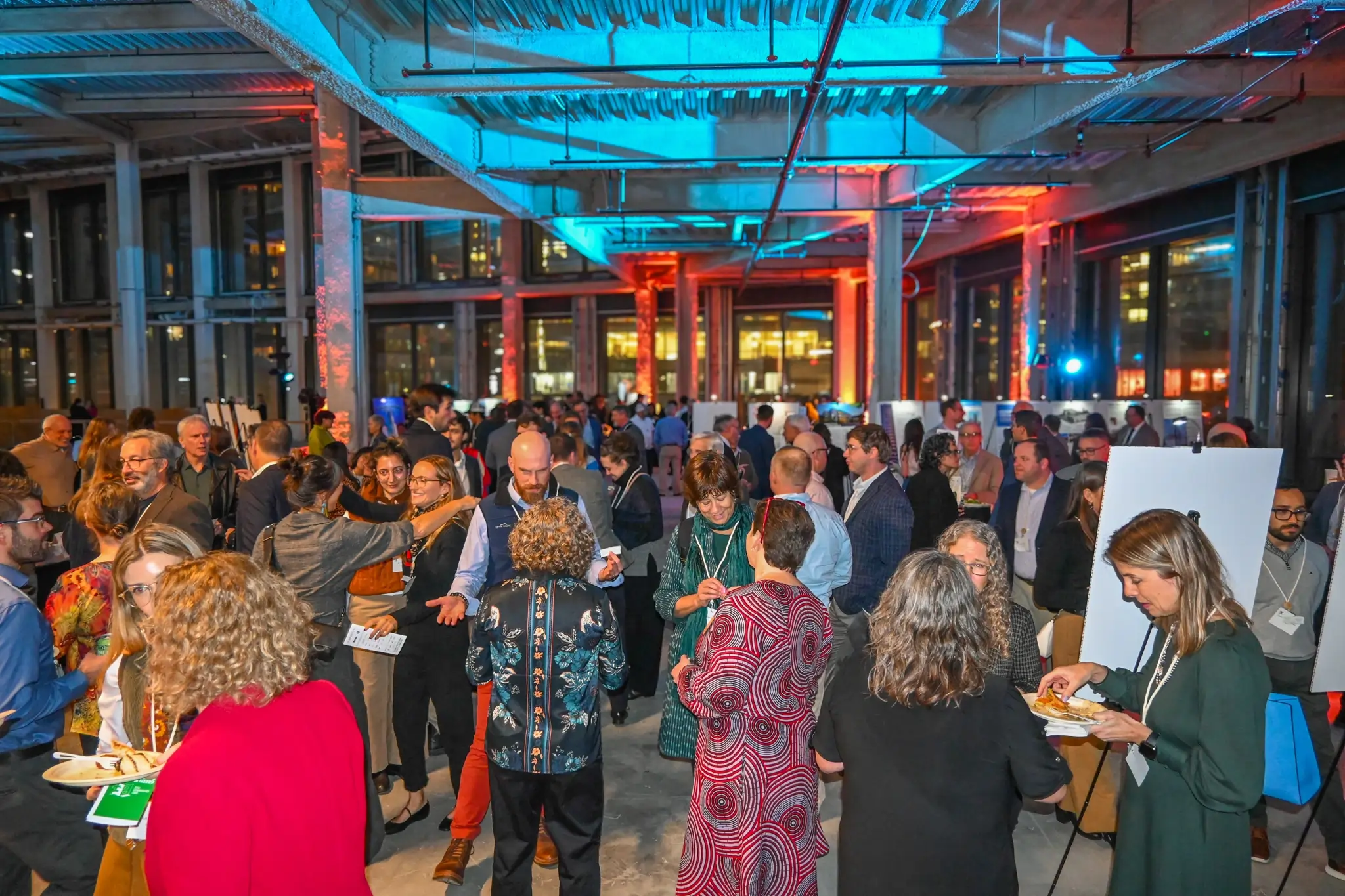
Green Building Showcase 2025

Founded in 2002 by Patagonia founder Yvon Chouinard and Blue Ribbon Flies founder Craig Mathews, 1% for the Planet connects businesses that commit to donating at least one percent of their annual sales with trusted environmental organizations making measurable change. Today, the network includes 11,689+ of business members and environmental partners across more than 110 countries, and members have directed more than $870 million to environmental initiatives worldwide. See their powerful ecosystem here.

As the buildings sector accounts for about one third of global greenhouse gas emissions, transforming how we design, construct, operate, and renovate buildings is one of the greatest opportunities to address climate change. At BE+, we believe the built environment can be a powerful climate solution while also improving public health, affordability, resilience, and quality of life for everyone.

“We’re thrilled to join this thriving network of organizations committed to advancing the triple bottom line of sustainability and innovating our way forward to a livable future for all of us,” said Meredith Elbaum, BE+ Executive Director. “There’s so much more we can do by working together across sectors and industries and by better aligning business with ecological and environmental challenges.”
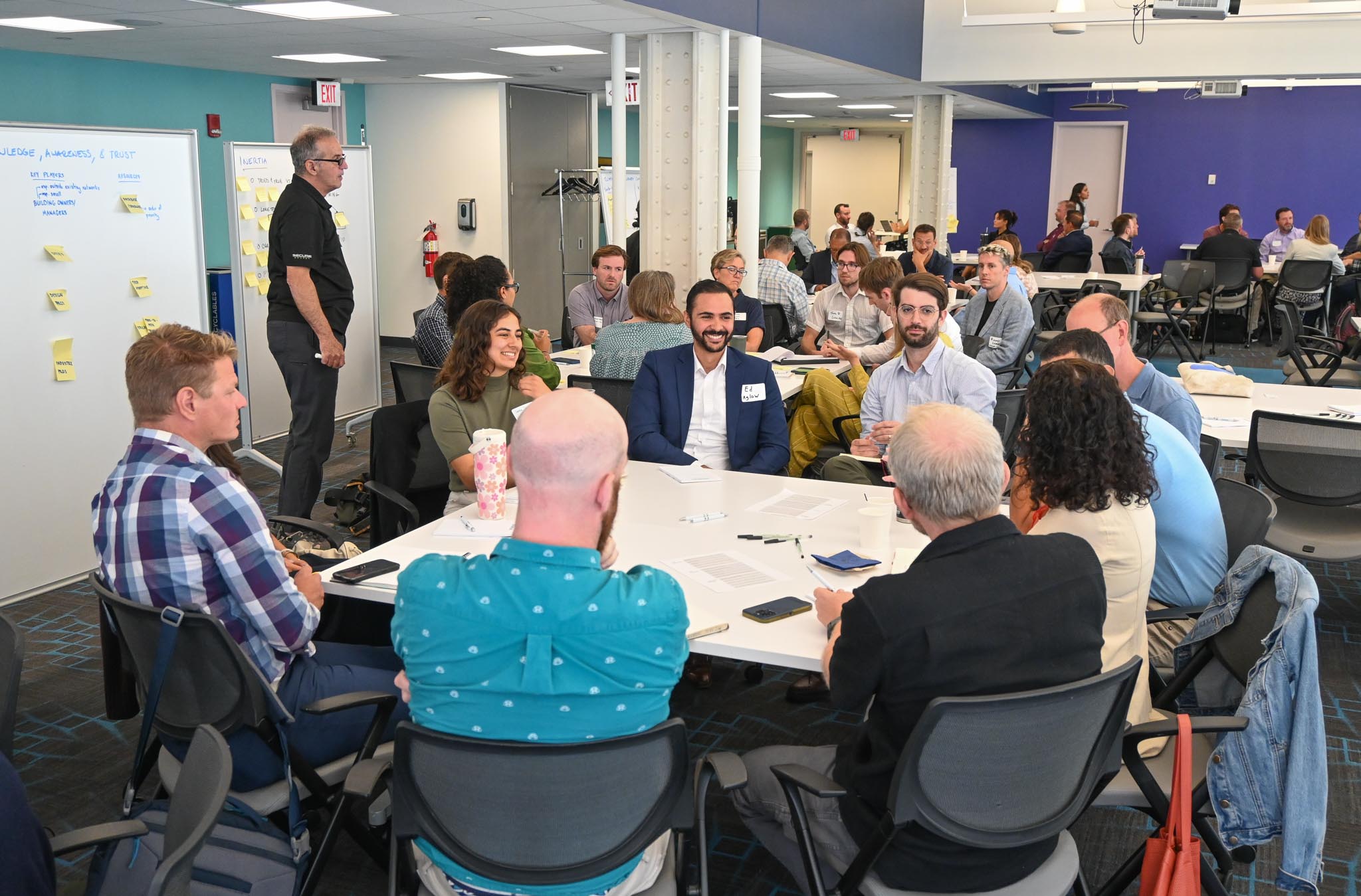
Existing Buildings Experts Summit 2025

Support from 1% for the Planet business members will help expand BE+’s ability to convene stakeholders, deliver educational programming, recognize industry leadership, and accelerate practical solutions that reduce emissions and improve building performance across Massachusetts and beyond.

“The intent of 1% for the Planet is to help fund these diverse environmental organizations so that collectively they can be a more powerful source in solving the world’s problems,” wrote Yvon Chouinard, co-founder of 1% for the Planet.

This partnership represents another important step in growing the coalition of organizations and businesses committed to creating a more sustainable future. We look forward to collaborating with 1% for the Planet members who recognize that investing in environmental action is also an investment in stronger communities and a healthier planet.

Now you can commit to 1% for the Planet as a Business Member and leverage your 1% giving commitment to drive sustainable and regenerative design, construction, and operations of the built environment in Massachusetts and beyond. To learn more about BE+’s work or to support us through the 1% for the Planet network, visit our 1% for the Planet profile.
Doubling Down on Justice in the Workplace

Doubling Down on Justice in the Workplace

With the annual Just Celebration right around the corner, we’re excited to celebrate organizations committed to creating a more socially equitable and transparent world. More than just a label and framework, the heart of the Just program lies in its community of practitioners who can share their experiences and remind everyone: we’re all in this together! At a time when justice, equity, diversity, and inclusion are explicitly under attack, we can all be recharged by the power of community cohesion and collaboration.

As we prepare for this year’s gathering on July 22nd organized by the BE+ Living Future Community, we’re sharing insights, reflections, and words of wisdom from local organizations at various stages of their Just journey. Whether you’re a long time Just participant or simply Just curious to learn about the tool from Living Future (formerly ILFI), we hope these reflections inspire your own journey. Beyond these stories, we invite you to join us on July 22nd for an evening to connect with fellow practitioners, exchange ideas, and celebrate the organizations advancing social equity across our industry.

Why Organizations Choose Just

“As we explored its core principles, it became clear that its focus on employee experience, health, well-being and meaningful community connections closely aligned with who we are and what we value as a firm. We were especially drawn to the way Just encourages organizations to take a thoughtful and intentional look at themselves while providing a clear path toward more equitable outcomes through action and accountability.” – PCA, introduced to the JUST program by Director of Sustainability DiAnn Tufts, an active member of Living Future. 

“When ILFI launched JUST in 2015, it immediately caught our attention because of how it was framed: not as a certification that asks organizations to make declarations, but as a tool that promotes disclosure, transparency, and accountability. In 2016, Bruner/Cott became the first company in New England to earn the JUST label, a milestone achievement we remain incredibly proud of. We came to JUST through our work in regenerative design and our long relationship with the International Living Future Institute and the Living Building Challenge. For us, JUST isn’t simply a framework or an internal accountability metric. It’s a structured way to examine how our organizational practices – pay equity, benefits, leadership composition, and community investment – align with our core values. It was also a natural fit for us, as a firm. We were already pursuing clients and projects rooted in regenerative design and Living Building Challenge principles, so adopting JUST felt like an extension of work we were already doing.” – Bruner/Cott Architects

“We have identified six core values that encapsulate our mission and vision. These values are integral to our strategic plan and guide our operations. Social Equity is a key element of the “triple bottom line” of sustainability and is foundational to our work. We’ve been a B Corp since 2011, so when the Just program came along, it was the natural next step for our organization. The specific focus of Just gave us a chance to look more closely at social equity and what it means for us. We first certified in 2019 and have recertified under v2 and again under v3. In general, Just aligns well with B Corp certification. We’re a diverse, employee-owned organization, but we don’t fit easily into the MBE/WBE framework. The Just label gives us a better way to demonstrate what our organization values.” – The Green Engineer

“We chose the Just program as a way to formalize how we approach transparency and accountability within our operations. It provides a clear, measurable framework to evaluate how we support our people, engage with our communities and strengthen our internal culture. 

What has kept us engaged is the level of accountability the program brings. It challenges us to continuously measure and improve on the factors that matter most, from employee wellbeing to community impact, while aligning with our broader commitment to holistic sustainability and the goals of clients pursuing Living Building Challenge projects.” – Consigli

“We were eager to engage with ILFI and Regenerative Design from their founding. The  ILFI leadership in elevating the green building effort was both opportune and profound- to actually discuss a framework for regenerative projects and communities.   We got involved in the JUST program as part of supporting the ILFI’s efforts to broaden the availability of sustainability planning and address the clear lack of understanding about Social Justice in the Environmental Movement and design/construction industry.” – Next Phase Studios

The Impact of Participating in Just

For many organizations, the greatest impact has been internal. The framework has prompted new conversations, strengthened workplace culture, formalized long-held values, and provided practical tools for continuous improvement.

“While many indicators have influenced our growth, Inclusion has been especially impactful. The Just process reinforced the importance of creating a culture where everyone feels a sense of belonging and has the opportunity to be heard, valued and supported. Through weekly all-staff meetings, open dialogue and a focus on employee mentorship, we have strengthened communication and transparency while creating more opportunities for employees to contribute to the ongoing evolution of our firm.

The process also prompted important conversations around equity and access. We recognized that our industry is not equally accessible to everyone, encouraging us to think more intentionally about how we create pathways for participation and opportunity. As part of this commitment, we have established affinity groups within our office culture that focus on engagement, inclusion and operationalizing our DEI commitments through our work. These groups help foster connection across the firm while ensuring we continue to listen, learn and create opportunities for all PCA employees and others with the same goals. More than anything, Just has reinforced the importance of maintaining an environment where people feel empowered to share their perspectives, contribute their ideas and grow both personally and professionally.” – PCA

“Pay equity and employee benefits.The application process required a structured analysis of our compensation scale, which allowed us to verify pay equity consistently across all pay levels and adjust where the data showed gaps. Each renewal builds on that, establishing a repeatable process for reviewing and verifying compensation data annually. On the benefits side, healthcare costs and plan options continue to evolve and shift rapidly from year to year. The Just framework requires us to measure our benefits against a defined standard rather than against last year’s plan, which keeps the conversation focused on what employees actually receive. For architecture firms, committing to providing equitable benefits isn’t optional—it’s how the profession invests in and retains people. Just gives us a structure to hold ourselves to that standard as conditions change.” – Bruner/Cott Architects

“By far, the greatest impact of our Just label is the internal effect on our organization. Our team has embraced the Just label, and that shared sense of purpose makes The Green Engineer is a place where people are excited to show up and do meaningful work. In recertifying under Just 3.0, we updated our policies and formally documented our commitment to social justice, equity, and employee engagement. We also used the enhanced framework to implement our JEDI initiatives more effectively. The updated framework provided clear metrics and actionable guidance, helping us improve equity across our workplace policies, decision-making processes, and client-facing interactions.” – The Green Engineer

“One of the most impactful changes came from tracking volunteer hours. Through the Just process, we identified an opportunity to do more and expanded our policy to provide 24 hours of paid volunteer time annually for each employee. This has strengthened our culture and reinforced our commitment to giving back.” – Consigli

Lessons Learned on the Journey to Getting the Just Label

“One of the more challenging aspects of the Just process was the level of transparency it requires. Organizations are asked to collect, analyze, document and share information that is not always widely communicated, creating a level of openness and accountability that can feel uncomfortable at times. The process is also a significant undertaking. Gathering, organizing and maintaining the data required to support each indicator takes considerable time and sustained effort across the organization. This responsibility can be particularly demanding for leadership team members who serve as stewards of specific indicators, balancing these internal commitments alongside their project, client and business responsibilities.” – PCA

“Formalizing what had been informal. Prior to earning our JUST label, Bruner/Cott’s culture had never been policy-driven. We had long relied on organic processes and relationships. Over time, our employee handbook hadn’t kept pace with our actual practices. JUST provided a new opportunity to think critically about what we were already doing and put it into writing. Things like living wage, gender equity, local sourcing, and volunteering weren’t new values for us, but hadn’t been formally documented as commitments that guide firm decisions and behaviors. That formalization process connected directly to what drew us to JUST in the first place: the program asks for disclosure and accountability, not declarations. It’s easy to say your firm values equity. It’s harder and more meaningful to measure, document, and make it visible. Gathering and disclosing sensitive operational data, including compensation, also took real internal work and a lot of trust.” – Bruner/Cott Architects

“One of the more challenging areas has been tracking and improving certain workforce-related metrics that are influenced by broader industry trends. While these factors can be complex, the process has reinforced our commitment to continuous improvement and identifying opportunities to make meaningful progress over time.” – Consigli

“With under 10 employees and one third part time by choice, the impacts of individual choices and accommodations on the overall presentation of data was difficult. We have part time employees, some with 20+ years of service who work schedules that are best for them, but perform all the work needed. And it is essential work. They have prorated, or better benefits and appreciate the arrangement. This has been going on long before wfh and Covid. It has become increasingly hard in the JUST data for these folks not to be seen as us taking advantage of them and not offering fulltime employment. There were several “categories” where Part Time employees work against the calculation or requirement. I really think that it felt like it was not able to capture how we were performing at all accurately.” – Next Phase Studios

What Surprised Them

“The Just process highlighted how important it is to move beyond good intentions and create systems of accountability. Through the renewal process, we recognized the need to decentralize ownership by assigning Thought Leaders to specific indicators throughout the leadership team. This shift helped embed Just principles more deeply throughout the organization, created greater accountability for progress and change and brought new perspectives and fresh thinking to the table, strengthening our ability to evolve as an organization.” – PCA

“The most surprising thing the JUST label surfaced for us was the gap between practice and policy. We assumed that because we operated fairly, we were covered. The application process revealed how much of what we did well existed nowhere on paper and identified a few areas where we weren’t performing as well as we believed. In 2016, our first label showed a worker happiness score at Level 1. By focusing on communication, project work, and design dialogue, we moved it to Level 3. We wouldn’t have known to work on it if we hadn’t measured it.” – Bruner/Cott Architects

“The Just label process brought greater visibility into areas where we could strengthen consistency across our organization. Having that level of transparency allowed us to take a closer look at our practices and continue making improvements over time.

Clients and partners who are familiar with the Just label recognize it as a meaningful demonstration of our commitment to transparency and continuous improvement. It supports conversations around shared values and long-term project goals.” – Consigli

“As always, actual metrics are profoundly helpful in understanding, reflecting, and changing behaviors. I think things we took for granted we did well, we saw opportunities for improvement. This could be at any scale from supply and waste procurement, to benefits, to transparency in operations.”  – Next Phase Studios

Advice for Other Organizations

“Be prepared to do the work. Just is more than a label. It is a framework that requires organizations to examine themselves honestly and commit to meaningful change. Before pursuing a label, take the time to understand whether you have the resources, leadership support and willingness to address difficult issues. The process will reveal opportunities for growth and challenge organizations to evolve in ways that better support employees and stakeholders.” – PCA

“Don’t wait until your scores look good! The JUST label is a baseline, not a report card. Its value lies in the honesty of acknowledging where you actually are, mapping what a path forward could look like, and identifying specific areas of improvement you might not have otherwise addressed. Some organizations may be hesitant to publish less-than-stellar scores, but in our experience, that disclosure is what makes improvement real and meaningful. The program itself is straightforward to learn. The harder part is accepting that there’s work to do, and that incremental, honest, measurable progress is the whole point.” – Bruner/Cott Architects

“Go sign up and do it. What are you waiting for?” – The Green Engineer

“Focus on transparency rather than achieving a perfect score. The value of the Just program is in understanding where you are today and using that insight to drive meaningful, continuous improvement.” – Consigli

What Does a Socially Just World Mean?

“A socially just world is one where people feel heard, valued and empowered to contribute purposefully regardless of their background or experience. It is a world where people feel safe, secure and supported across all aspects of their identities and experiences and are empowered to live their best lives among their families, friends and communities. It is also a world where organizations and companies take responsibility for their impact on employees, communities and the people they serve, and where strong socially responsible policies create measurable outcomes rather than aspirational goals. Meaningful change happens when organizations establish accountability, regularly evaluate their performance and make adjustments that improve transparency, opportunity, well-being and trust.

Recognizing this, we also believe there is an opportunity for Living Future to further elevate the visibility of the Just label across local, national and global business communities. Greater adoption by corporations, institutions and public organizations could significantly expand its impact and help bring these principles to more people and communities around the world.” – PCA

“Good looks like workplaces where compensation, benefits, and opportunity are abundant for everyone who joins the firm — where how well you negotiate isn’t a factor, and where that’s verifiable, not just asserted. Our profession shapes communities through the built environment. We should be able to demonstrate that we run our own organizations the way we’d want the places we design to function. That alignment between what we build and how we operate matters. JUST helps by making disclosure normal. When enough organizations publish their actual practices, transparency stops being a differentiator and becomes the expectation — and that’s the point at which the industry evolves. How do we leave our profession better than when we entered it? JUST is one way to answer that.” – Bruner/Cott Architects

“A difficult question without easy answers. I can see many examples showing that we do not currently live in a socially just world. By itself, any rating system is not going to change the world. The best we can do as individuals is to try to live a moral life. Tools like Just help create a community to support each other in that effort.” – The Green Engineer

“A stronger industry is one where baseline benefits and protections, such as fair wages and access to supportive workplace policies, are more consistent across the workforce. Programs like Just help move the industry in that direction by encouraging transparency and shared standards.” – Consigli

“I think that Environmental and Social Justice are directly linked. Much beyond a project level, it is pretty discouraging out there. I think the Just program and the efforts it represents will continue the dialogue on this interconnection regardless of the distractions.”  – Next Phase Studios

We are incredibly grateful for our Just Celebration sponsors who have shared insights from their Just journeys, and we hope that their experiences can help inform and inspire your own journey. Together, we can raise the bar for social justice, equity, diversity, impact, and belonging across the industry and beyond. Take one step towards Just and join us at the Just Celebration on July 22nd!

Thank you to our Sponsors!

Linnean Solutions
Consigli
Bruner/Cott
Byggmeister
Shawmut
Welcome Our 2026 Summer Interns!

Welcome Our 2026 Summer Interns!

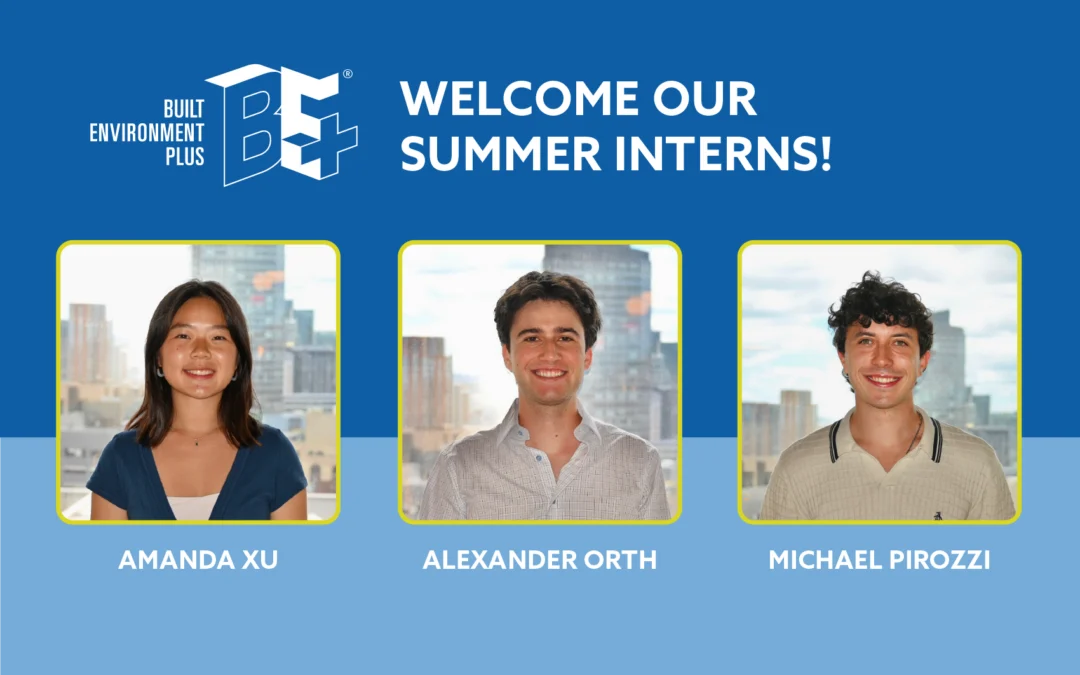
Join us in welcoming our 2026 Summer interns: Amanda Xu, Alexander Orth (returning to BE+ for another season), and Michael Pirozzi. Already making an impact across the BE+ community, Amanda is helping us prepare for Building Tech Forum while supporting our Communities program. Alexander and Michael are working together to expand Built Environment Connects by adding new companies, professionals, and projects. We look forward to their contributions this summer as they help advance our mission to foster a more sustainable and regenerative built environment.

Amanda Xu

Amanda Xu

Hi, my name is Amanda, and I’m so excited to be working with the BE+ team this summer! I’m a rising senior at Tufts University, studying Biopsychology & Environmental Studies. In my spare time, I love to be in the great outdoors – or curled up at home with a good book. While I am still exploring my passions in the environmental fields, I’m eager to learn more about the systems, policies, and people that shape our built environment and advance sustainability. I look forward to contributing to and learning from the Community team at BE+!

Connect with Amanda Xu on LinkedIn

Alexander Orth

My name is Xander, and I am delighted to intern at BE+ this summer! I’m a recent graduate of Tufts University where I studied Political Science and Environmental Studies. In my spare time, I’m an avid hiker and photographer, and I’m passionate about creating urban spaces which are both functional and sustainable. I’m grateful for the opportunity to carry on my work from the spring, particularly in strengthening Built Environment Connects through engaging green building professionals.

Connect with Alexander Orth on LinkedIn

Xander Orth
Michael Pirozzi

Michael Pirozzi

My name is Mike, and I am thrilled to work as an intern for BE+ this summer! I am going to be a senior at Northeastern University studying Environmental Science and Economics with a Business Administration minor. I love working out and thrifting in my free time. I am so excited to get the opportunity to work for BE+ and create a balance between the environment and human benefit through sustainable developments, and I look forward to learning more about the community through this opportunity.

Connect with Michael Pirozzi on LinkedIn

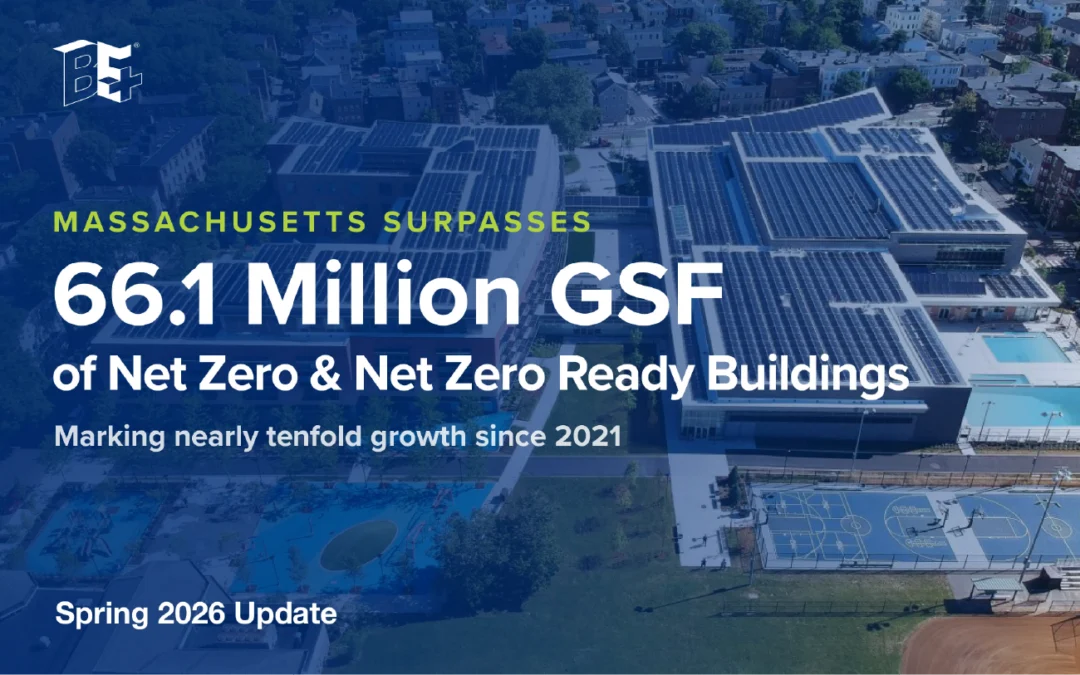
Massachusetts Surpasses 66.1 Million Gross Square Feet of Net Zero and Net Zero Ready Buildings, Marking Nearly Tenfold Growth Since 2021

Massachusetts Surpasses 66.1 Million Gross Square Feet of Net Zero and Net Zero Ready Buildings, Marking Nearly Tenfold Growth Since 2021

Massachusetts continues to demonstrate strong and consistent growth in high-performance building development, according to our new statewide report, Massachusetts is Going Net Zero: Spring 2026 Update.

From Cost Concerns to Market Transformation
We started this research in 2021 by collecting real project data to demonstrate that despite a strong narrative about cost fears, there was little to no cost premium for net zero energy buildings. Since tracking began in 2021, documented Net Zero and Net Zero Ready building stock in Massachusetts has grown from 7.2 million GSF to 66.1 million GSF, with an increase of 17.7 million GSF since 2024 alone and a nearly tenfold expansion in just five years. This data doesn’t even capture single family homes or multifamily residential buildings under 15k GSF or 15 units. Of the 19.3 million GSF with reported cost data, 71% reported <1% construction cost premium to achieve Net Zero Ready.

“At a time when energy prices are soaring from political instability, it’s more important than ever that we invest in highly efficient buildings that cut out fossil fuels and rely on renewable, low-carbon sources,” said Meredith Elbaum, Executive Director of Built Environment Plus. “Fortunately Massachusetts has had the foresight and leadership to embrace high performance buildings, with improving standards, forward-thinking energy codes, and extensive investment in clean energy infrastructure, a thriving climate tech ecosystem, and vital support through incentives. We should be doubling down, not taking our foot off the pedal.”

Massachusetts Is No Longer in the Early-Adopter Phase
The data collection for the report happened exclusively through Built Environment Connects, a dynamic discovery tool bridging the people, companies, and high-performance buildings represented in this report. With over 500 projects, 220 professionals, and 200 companies, the report concludes that Massachusetts has moved beyond early adoption and is now firmly in a phase of large-scale implementation.

Key findings from the report include:

• The Net Zero and Net Zero Ready building stock exceeds 66.1 million GSF, across 500+ projects, and continues to expand.
• Multi-family and affordable housing’s combined 20.9 million GSF are leading the way for Net Zero development in Massachusetts
• Lab/Tech/Science grew by 20% since 2024 up to 16.5 million GSF, making up the majority of the found Net Zero Ready space
• Of the 19.3 million GSF with reported cost data, 71% reported <1% construction cost premium to achieve Net Zero Ready.
• Adoption of heat pump technology across all building types
• Since 2024, nearly twice as many projects have reported being all-electric for domestic hot water, totaling 39.7 million GSF.

The Policies Behind the Progress
The report attributes much of this momentum to Massachusetts’ strong combination of climate policy, utility programs, and market adoption strategies that continue to lower operational costs and support electrification at scale. The majority of this data was shared before the adoption of the current Massachusetts Energy Code. In municipalities that have adopted the current Stretch and Specialized Energy Codes, Net Zero Ready is the new baseline, effectively eliminating the existence of a cost premium. In 2024, we added an option, “We didn’t calculate the cost premium.” Of the projects that did not calculate cost, over half said Net Zero was necessitated by code or client preference.

The Impact of Energy Efficiency Programs
Programs such as Mass Save have played a critical role in reducing energy demand, improving building performance, and helping projects transition away from fossil fuels cost-effectively. These incentives generate $3.50 in energy cost savings for every $1 invested and they have created the new standard for building. However, industry leaders caution that this progress could slow if proposed cuts to Mass Save move forward.

“It would disrupt planned investments, strand ongoing projects, and break commitments to households and businesses that have already begun upgrades,” said the Alliance for Climate Transition.

Experts warn that weakening Massachusetts’ nationally recognized energy efficiency infrastructure could increase energy costs, reduce demand-side efficiency gains, and disrupt the growing pipeline of electrification projects that are driving the Commonwealth’s Net Zero transition.

What’s Next?
As Massachusetts continues to scale high-performance building development, the report makes it clear that Net Zero is no longer a niche market, but it is rapidly becoming the standard for new construction and major renovations across the Commonwealth. At the same time, we are helping building owners tackle the decarbonization of their existing buildings through a new program, the Building Performance Exchange, in partnership with the Mass Clean Energy Center. By taking on new construction and existing buildings together, Massachusetts can ensure that high performance buildings are the norm rather than the exception.

Reframing the Future

Reframing the Future

The following post was provided by Turner Construction.
Boston exhibit shows low-carbon construction is ready now

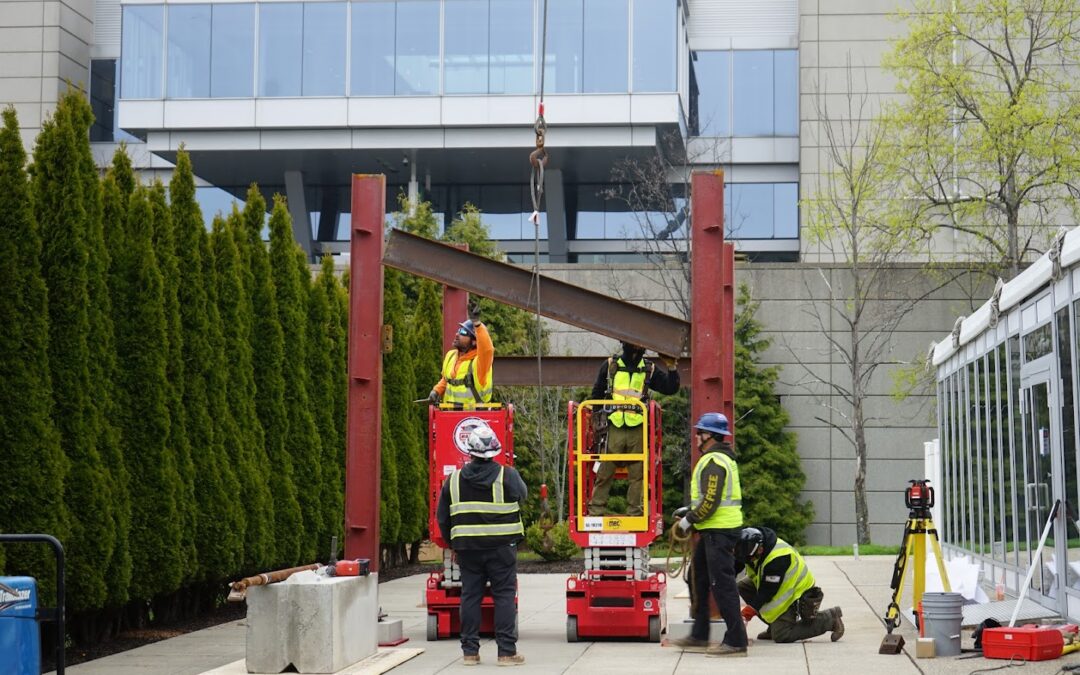
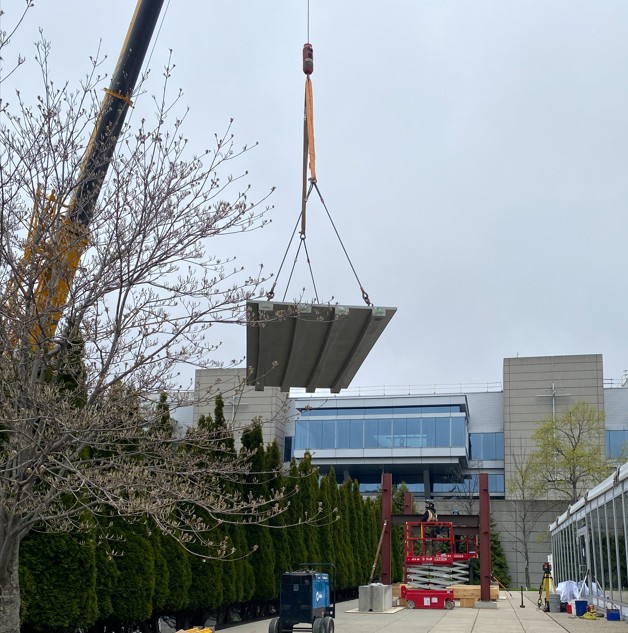
A temporary pavilion was constructed as part of the Structural Engineering Institute’s Structures Congress, “Reframing the Future: With Low-Carbon Construction.”  It brought together a nationwide collaborative team to demonstrate that high-performance, low-embodied-carbon building systems are no longer theoretical, they are ready for commercial use today.

The exhibit serves as a physical example of how sustainable construction can be achieved using materials and systems that already exist. It incorporates principles of a circular economy – reuse, biogenic materials, and design for deconstruction, offering a practical roadmap toward a more sustainable built environment.

Organized in partnership with Buro Happold, Cambium Carbon, Forma Systems, Second Structure, Turner Construction Company, and MIT, the project comes five years into the SE 2050 Commitment and stands as both proof-of-concept and a call to action.

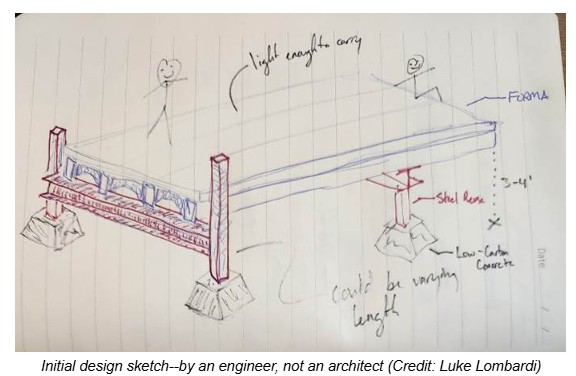
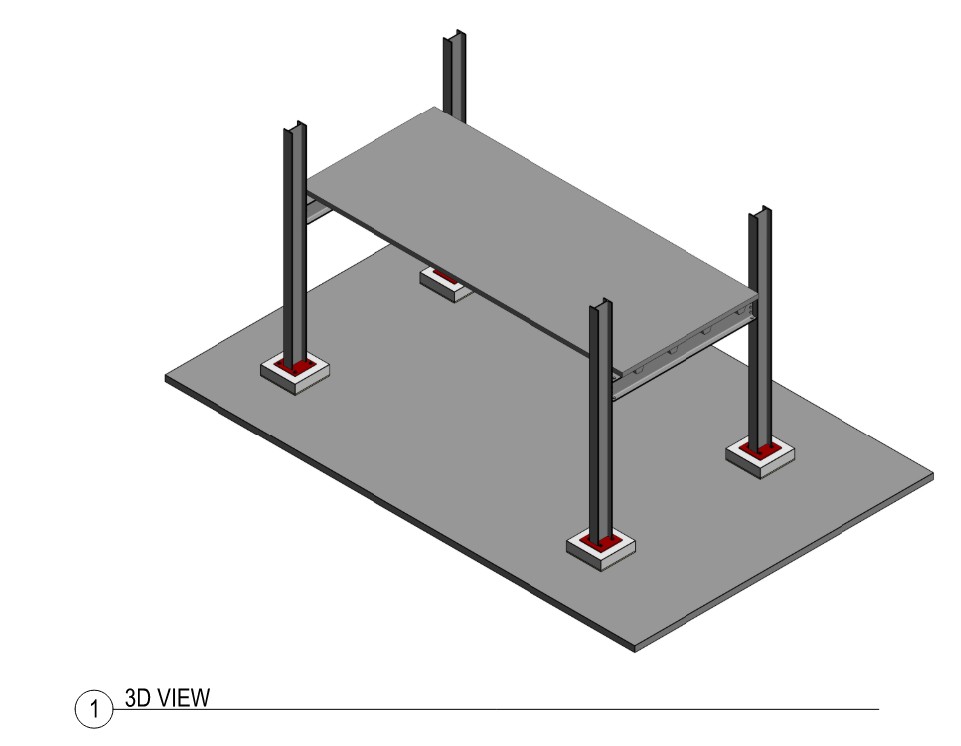
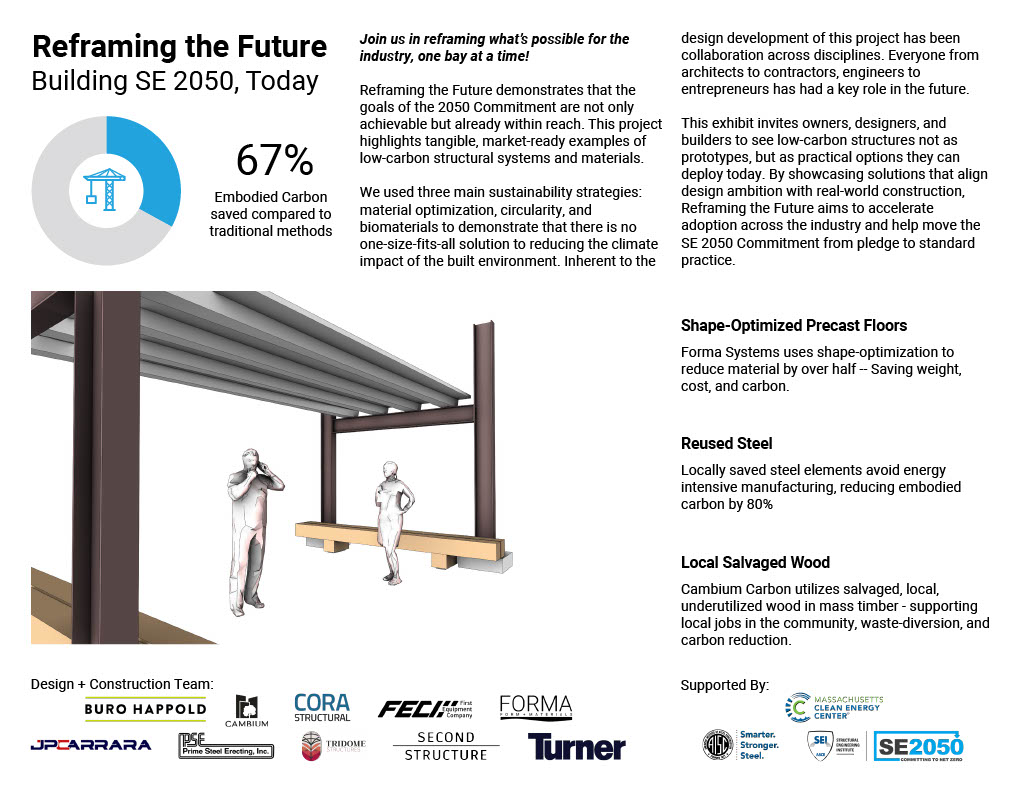
The idea and strategy: At its core, the pavilion-like structure highlights three key strategies for reducing carbon in construction: material optimization, circularity, and biomaterials, visually demonstrating how these approaches can work together to deliver meaningful impact.

Initial design sketch by an engineer
3D view of pavilion-like structure

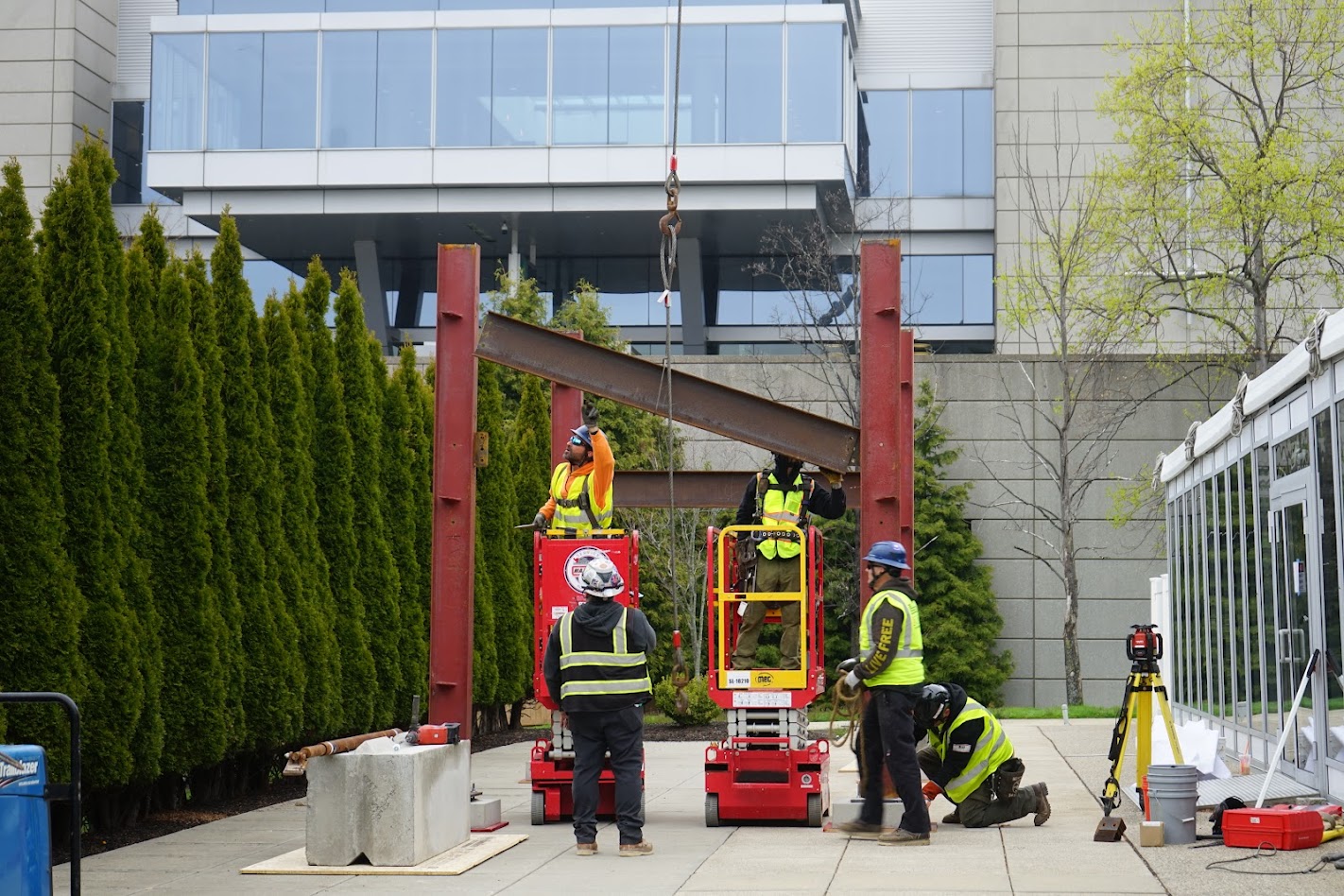
Reused steel: The structure also showcases reclaimed steel sourced from a nearby deconstruction project. While steel is commonly recycled, reuse eliminates the need for energy-intensive melting and recasting, preserving the material’s embodied carbon and reducing demand for new resources. All steel used in the exhibit traveled just over 60 miles, and every connection was designed to be demountable, allowing the structure to be disassembled and reused in future installations.

Reclaimed steel sourced from a nearby deconstruction project

Optimized precast: At the center of the exhibit is a shape-optimized, reinforced concrete floor slab developed by MIT spinoff Forma Systems. Designed to deliver the same structural performance as conventional systems while using significantly less material, the slab is lighter, shallower, and can reduce carbon emissions by up to 70 percent. The multi-ribbed slab is just 6¾ inches deep and weighs roughly half as much as a comparable system – reducing foundation demands, transportation costs, and installation time.

Optimized precast

Salvaged wood: The project also incorporates salvaged wood supplied by Cambium Carbon, sourced locally and manufactured into glued-laminated timber beams by Tridome Structures. The approach supports local jobs, reduces waste, and stores carbon all while maintaining a strong connection to place.

Salvaged wood supplied by Cambium Carbon

The final assembly: Together, these strategies form a fully code-compliant, permitted, and insured prototype that demonstrates what is possible today.

Weighing approximately 3.5 tons, the structure is more than 50 percent lighter than a comparable cast-in-place concrete system and is estimated to reduce its carbon footprint by two-thirds.

Perhaps most importantly, the exhibit underscores that achieving low-carbon construction at scale requires coordination across the entire supply chain, from material sourcing to final assembly.

Reframing the Future results
Results

Passive House Training Opportunities: Advance Your Career at Low or No Cost

Passive House Training Opportunities: Advance Your Career at Low or No Cost

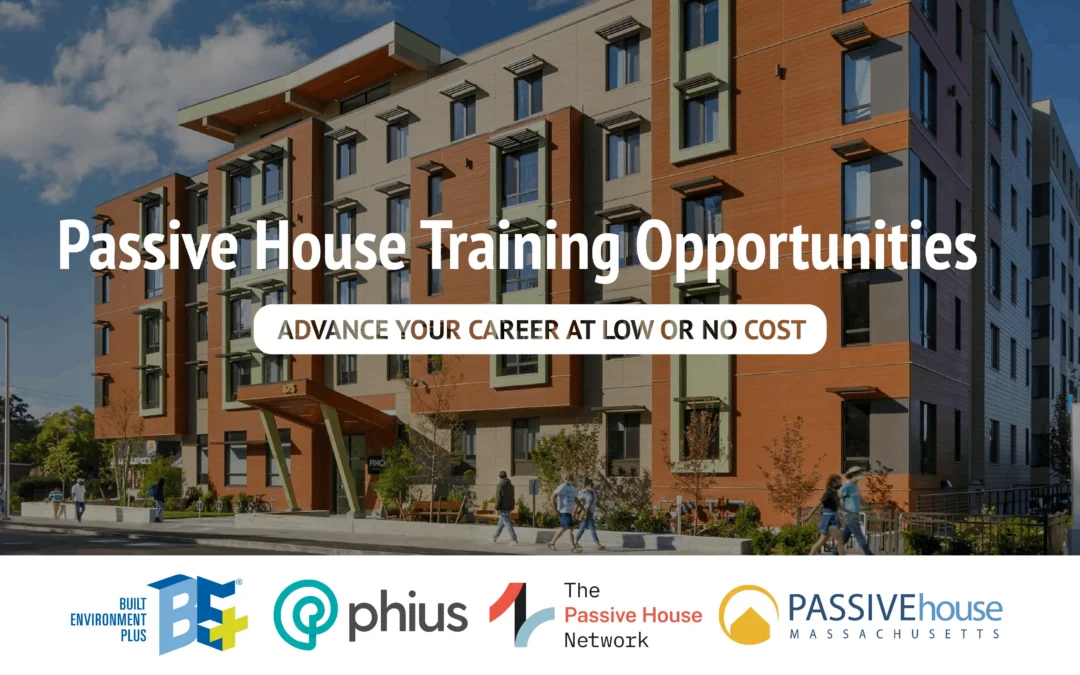
Built Environment Plus successfully leverages significant Massachusetts Workforce Training Fund grants to make a wide variety of Passive House education more accessible. We offer Phius, Passive House Network/Passive House Institute, and Passive House Massachusetts trainings to help architects, engineers, and construction professionals gain in-demand skills in energy-efficient design and construction. In 2025, we supported 45 professionals in earning passive house credentials. With grant funding available for all BE+ trainings, let this be the year that you become that passive house expert at your firm!

Learn about the different passive house learning pathways depending on your profession and experience level.

You can take any of the following trainings for free or for a reduced cost through BE+:

📐 Phius Certified Consultant (CPHC) Training

The CPHC training includes self-paced learning modules and live learning sessions that are delivered either virtually or in-person. The course is designed for architects, engineers and design professionals who already have a basic understanding of building science, an architectural background or hands-on building experience. Topics covered include building science fundamentals, high performance enclosures, cost-optimization, climate-specific design and detailing, high performance MEP systems, ventilation strategies, quality control strategies, Phius Certification requirements, renewable energy systems, and passive building physics. BE+ offers open enrollment every month under the Express Grant.

🛠 Phius Certified Builder (CPHB) Training

The CPHB training includes self-paced learning modules and live learning sessions that are delivered either virtually or in-person. The course is designed for construction professionals who want to understand the application of passive house building techniques. Topics include airtight enclosures, high-performance window installation, passive design strategies, field quality assurance, and site management. BE+ offers open enrollment every month under the Express Grant.

“The Phius courses from Built Environment Plus are both rigorous and practical, helping our team achieve Passive House Builder Certification (CPHB). The strength of their curriculum and instructors inspired us to expand certification across all operational roles—from planners to field superintendents, and even the CEO.

We’ve gained deep, practical fluency in Passive House that is already making a real impact on our jobsites. For us, PHIUS goes beyond environmental responsibility—it’s a model for high-performance execution that aligns with TOCCI’s mission: Building Harmony, Maximizing Results.”

John Tocci, CEO, Tocci Construct, LLC

🏢 Phius WUFI® Passive Advanced Multifamily

This live, online course is intended for multifamily WUFI Passive users who have basic prior experience with the software and want to fully understand WUFI’s capabilities and ensure they are utilizing this tool to the fullest extent. Attendees will learn how WUFI “can enhance, streamline, and optimize the design and certification of passive building projects if integrated into the design process properly.” BE+ offers this course several times a year.

🏚 Phius WUFI Passive Single Family

This live, online course is intended for architects, engineers, and design professionals without WUFI Passive experience or those who have had some exposure through Phius Certified Consultant (CPHC) training, but have not explored application yet. BE+ offers this course several times a year.

📏 Phius Certified Rater Training

This course includes self-paced learning modules and live learning sessions that are delivered either virtually or in-person. The training is intended for RESNET HERS Raters and other testing and commissioning professionals with experience working on single-family homes, townhomes, and low-rise residential buildings.  While this training does not have prerequisites, the credential exam does, including that participants are fully certified as a RESNET HERS Rater (excluding: CA and AK). View Phius Rater exam prerequisites here, as they vary by location. BE+ offers this course several times a year.

📋 Phius Certified Verifier Training

This course includes self-paced learning modules and live, online learning sessions and is intended for testing and commissioning professionals with multifamily and non-residential building experience. Participants will learn how to guarantee quality assurance, including on-site inspections and performance testing throughout all stages of the construction process. Topics include building science, enclosure systems, high-performance mechanical systems, large building air-tightness testing strategies and protocols for Phius certification compliance. BE+ offers this course several times a year.

🖥 Phius Introduction to THERM Workshop

This course is delivered live, either in-person or virtually and is intended for a broad spectrum of building industry professionals. Basic understanding of thermal bridging and thermal bridging modeling is recommended, however there are no previous training requirements. If you are interested but don’t feel confident in these foundational topics, there are supplemental pre-course materials provided to students free of charge. BE+ offers this course several times a year.

📐 Certified Passive House Designer (PHI) Training

This course is delivered live, either in-person or virtually and is intended for a broad spectrum of building industry professionals. This course is specifically designed to teach the international Passive House Standard (PHI) to design and construction professionals in the U.S. and is required prior to taking the CPHD/C professional certification exam. BE+ offers this course several times a year.

🏚 Passive House 101: An Introduction To Passive Buildings

This course is delivered live, either in-person or virtually and is intended for a broad spectrum of building industry professionals. This training introduces a performance-first design and construction model that optimizes buildings for durability, health, comfort, and low operational costs while minimizing energy demand. We explore the core principles of Passive House delivery—from airtight construction and thermal bridge-free design to balanced ventilation—and demonstrate how an integrated process makes these goals both achievable and financially viable.

📐 PH 120: The Architect’s Role in Passive Building

This course is delivered live, either in-person or virtually and is designed for architects and design professionals looking to expand their expertise into passive building. The focus of this course is the foundational knowledge needed to navigate the complexities of Passive House delivery, including the mindset and technical awareness to effectively support a collaborative Passive House team. Participants will gain a high-level roadmap to help identify and avoid common design pitfalls while gaining a clear understanding of the attention to detail necessary to successfully deliver passive buildings.

👷 Phius Certified Trades Professional

This course includes self-paced learning modules paired with 3 days of in-person instruction and live virtual class sessions. The training is intended for construction professionals with foundational carpentry skills and a desire to learn about advancing their understanding of building science and related construction techniques. Attendees will learn the fundamentals of passive building and how to implement passive house designs into projects. Certified Trades Professionals may go on to earn specializations to become Enclosure, MEP or Master Trades specialists.

“The Workforce Training Grant has supported Payette staff in learning new tools and skills that enables us to continue to push our designs in order to create better buildings.”

Andrea Love, Principal and Director of Building Science, Payette

💲Securing Funding:

If you are interested in taking advantage of available funding opportunities, follow the process below to learn more about available opportunities and the application process.

Funding Opportunities:

Express Grant
Nearly all BE+ training is Express Grant eligible for companies with 100 or less Massachusetts employees. Confirm your eligibility and submit an Express application now to receive up to 100% reimbursement for applicable BE+ courses

Step 1: Submit Express Grant Application
All you need to complete the application are 20 minutes of your time, a few documents, and the course information listed on our website. You’ll have one full year from grant approval to take your course(s).

Step 2: Register for Training
If you’re looking for a different passive house course, check our course catalog and complete the training interest form. Learn more about the registration process from our Phius Roadmap.

MassSave Incentives
Those who are ineligible for the Express Program may be eligible for 50% reimbursement via Mass Save’s Passive House & All-Electric Homes Training incentives.

General Grant
If you’re not eligible for the Express Grant, consider pursuing the General Grant program. Learn more.

Questions about these trainings, the grant application process, or your eligibility to participate? Contact us at education@builtenvironmentplus.org or schedule time with our Education Director here.

View our trainings page to see upcoming BE+ courses. If there are other sustainable design, construction or operations courses that you are interested in, but do not see listed, reach out to our education team.

Don’t Stop Us Now: Advancing Retrofit Solutions Together

Don’t Stop Us Now: Advancing Retrofit Solutions Together

NESEA’s 2026 BuildingEnergy Boston conference, themed “Don’t Stop Us Now”, is set to hone in on the challenges and barriers building professionals are facing while reinforcing that we are not alone in solving them. That’s especially true for existing buildings where technical, financial, and operational challenges can stall projects or deter it from success.

Existing buildings account for 35% of Massachusetts emissions, making retrofits an essential step towards decarbonization. With new building performance standards in effect in Cambridge, Boston, and Newton, building owners are under pressure to reduce their emissions and energy use while improving health, resiliency, and comfort.

BE+ has launched the Building Performance Exchange to bridge the gap between owners and practitioners with the primary goal of connecting stakeholders with helpful resources, tools, and expertise to make retrofits easier and more successful.

Here are 11 sessions at BuildingEnergy Boston this year that highlight crucial aspects of retrofitting existing buildings, from planning to implementation.

Building Science Best Practices
Two crucial components of retrofitting are holistic system-wide planning and granular component-specific upgrades. Building science practitioners with diverse backgrounds and expertise in these areas gather at BuildingEnergy to present their latest discovery or demonstrate tested and viable strategies.

These two sessions focus on the difficulties found among existing buildings and the best practices for a better solution.

Misalignment between an energy model and reality can be frustrating when budgets are built around projected savings. This is why investigating potential causes is a valuable first step. Retrocommissioning can reveal why systems are not living up to their expectations, often providing straightforward solutions, such as educating staff on proper use of a building management system or fixing imbalances and leaks in a distribution system. Reducing the building’s operational and embodied carbon impact within the existing building shell may be challenging, but it’s achievable with guidance from the experts.

Making the Budget Work
Financing remains one of the biggest barriers in retrofit projects, especially with sudden program cuts and expensive electric rates. These sessions dedicate their time to navigating the complexities of capital and the art of financing in finer detail.

Learning the functions both behind and in front of a utility meter empowers owners to make the best financial decisions for their buildings. Moreover, finding the right electricity rate structure and dodging peak demand charges with smarter equipment use can help balance operational expenses. Analyzing the hidden health and societal costs of these financial decisions is vital to thoughtful and equitable improvement of the built environment.

Learning by Example
Case studies demonstrate project experiences, shortcomings and barriers, but also shed light on replicable strategies that are proven to work. These sessions showcase case studies of commercial and large portfolio decarbonization projects—sharing both positive and negative experiences.

Show us the Data!
In an industry of performance-based policy, data is essential. These presenters dig deep into energy, emissions, and cost data, finding trends, and paving the way for others to learn from both success and failure.

Tracking past and modeling future data is the best strategy to monitor building performance. There are more efforts than ever to prove that energy conservation measures and building upgrades are on the right path. Building Performance Standards illuminate the fruits of our labor, as a policy-driven approach to measuring building performance.To identify opportunities for improvement, data-driven decisions support wider and more effective technology use.

BuildingEnergy Boston marks its 51st year with a robust selection of sessions, highlighting the innovation in existing buildings. Out of the 45+ sessions, these 11 sessions offer insight into the important pieces of the puzzle of retrofitting existing buildings. Join us at MassCEC’s sponsored session, “Scope vs. Carbon: Stories of Decarbonizing Multi-Family Buildings,” to hear from project teams as they share insight on scope, timeline, and key decisions. Explore our other sessions and find us tabling just outside the trade show floor!

Welcome Our 2026 Spring Intern!

Welcome Our 2026 Spring Intern!

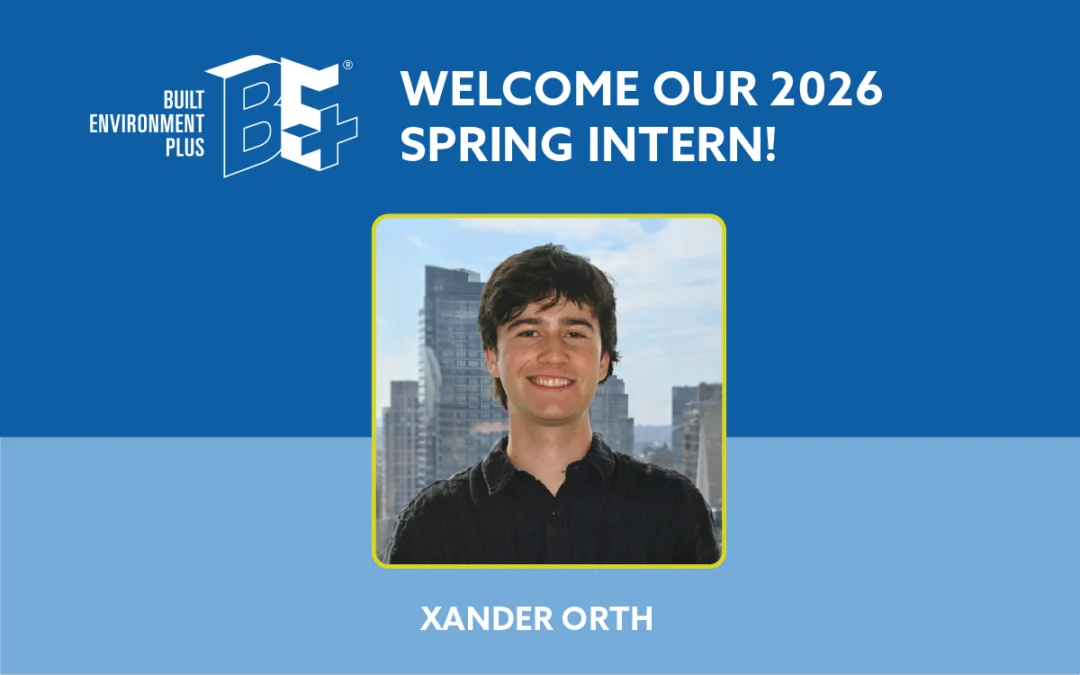
Welcome 2026 Spring Intern Xander Orth! We’re excited to have him on board supporting Built Environment Connects and advancing our mission forward to bring a more sustainable and regenerative design, construction, and operations across the built environment. With his passions for the environment and sustainability, we’re excited to see the impact he’ll make with the Connects team this spring.

Xander Orth
Xander Orth

My name is Xander, and I am delighted to intern at BE+ this spring! I am a senior at Tufts University where I study Political Science and Environmental Studies. In my spare time, I’m an avid hiker and photographer, and I’m passionate about creating urban spaces which are both functional and sustainable. I’m grateful for this opportunity to work with BE+, and I’m particularly excited to assist in strengthening Built Environment Connects through researching Massachusetts green building projects, setting up company profiles, and contacting green building professionals and companies.

Connect with Xander Orth on LinkedIn

2025: Strengthening the Built Environment Workforce: A Year in Review

2025: Strengthening the Built Environment Workforce: A Year in Review

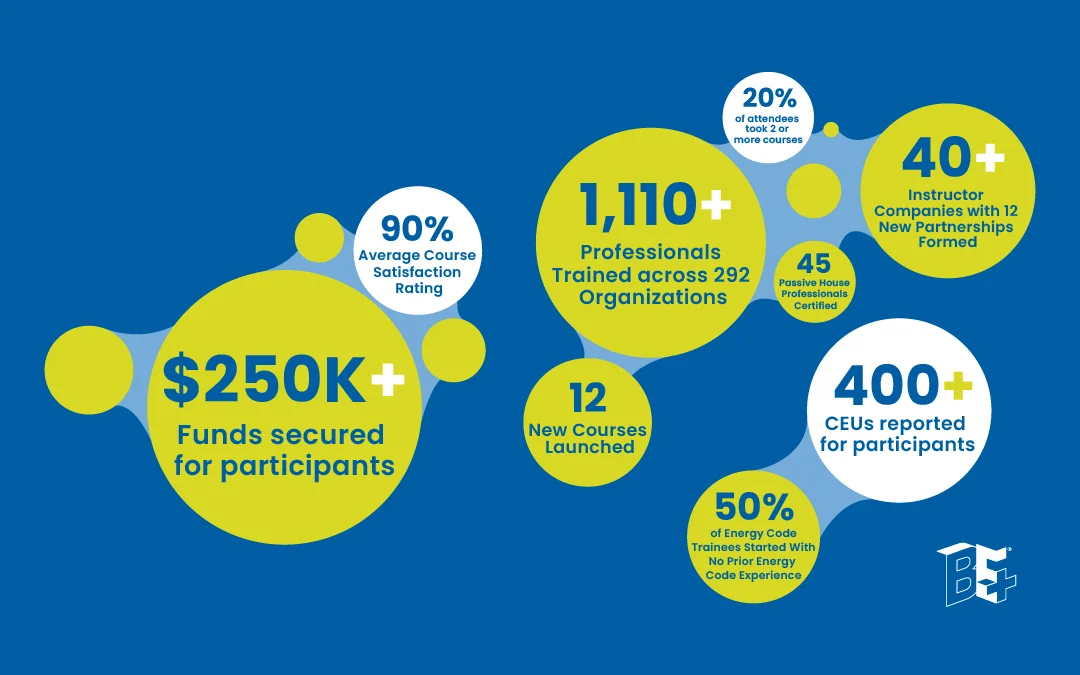
In the past year, the BE+ Education program has supported workforce development in Massachusetts by securing more than $250,000 worth of funding for organizations to use towards free and deeply discounted BE+ courses. With 1,100 total professionals trained across 292 organizations, BE+ provided over 400 AIA continuing education credits to support our community with their career development and upskilling. 

As a result, one company reported a 30% increase of in-house energy and daylight modeling and sustainable material assessments and another reported 50% more energy modelers on staff. Strong repeat engagement remained a hallmark of the program, with over 20% of participants returning for multiple courses and companies averaging three trainings each. 

With our roster of 40+ expert instructors and 12 new partnerships added this year alone, we are well-positioned to help practitioners meet the industry’s evolving standards.

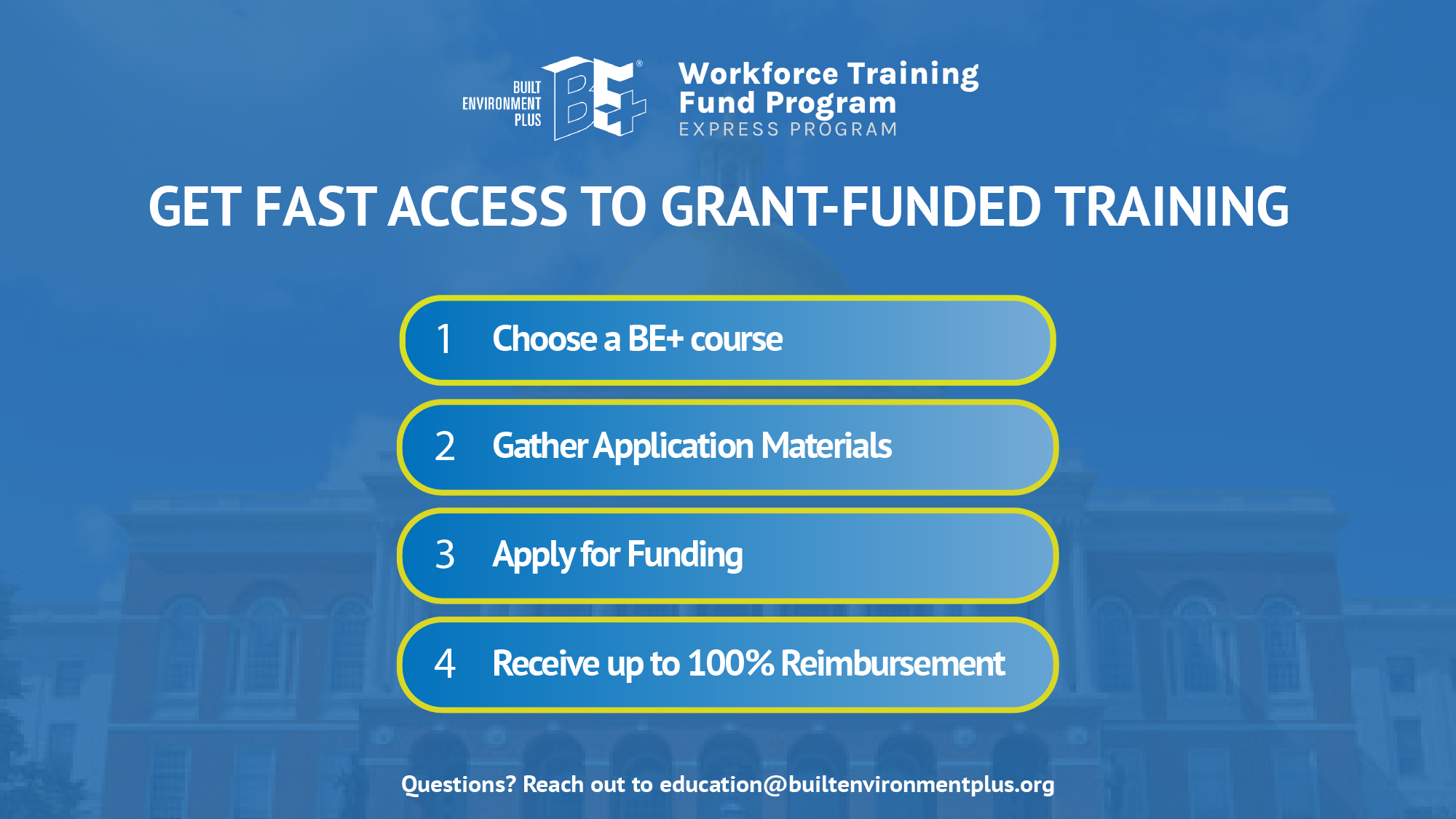
Get Fast Access to Grant-Funded Training: Choose a BE+ course, Gather Application Materials, Apply for Funding, Receive up to 100% Reimbursement. Questions? Reach out to @education@builtenvironmentplus.org

BE+ as a Workforce Funding Pathway for Upskilling

Through the Workforce Training Fund Program, we supported low-cost advanced credentialing, with 21 new LEED accredited trainees and 45 professionals earning Passive House accreditation. Together, these outcomes reflect BE+’s continued commitment to workforce development as a critical lever for climate action and industry transformation.

Learn about Workforce Funding Grants here for BE+ and partner courses.
Explore funding opportunities to become a Phius Certified Professional, explore WUFI and THERM. Check out our Phius Registration Roadmap to determine how & when to apply for funding grants!

Collage of promotional graphics of BE+ course offerings

Quality and relevance remained central to our approach. Courses earned an average satisfaction rating of 90%, reinforcing the program’s reputation for excellence. Top-performing offerings—including LEED v5: An Early Look, Massachusetts energy code trainings, Phius Certified Passive House Consultant trainings and our new Tech to Transformation: Building Better webinar series—reflect growing demand for technical rigor to meet evolving building standards.

In partnership with the DOER and the sponsors of Mass Save, BE+ subsidized over 250 seats in 2025 for the MA Stretch Energy Code Training Series

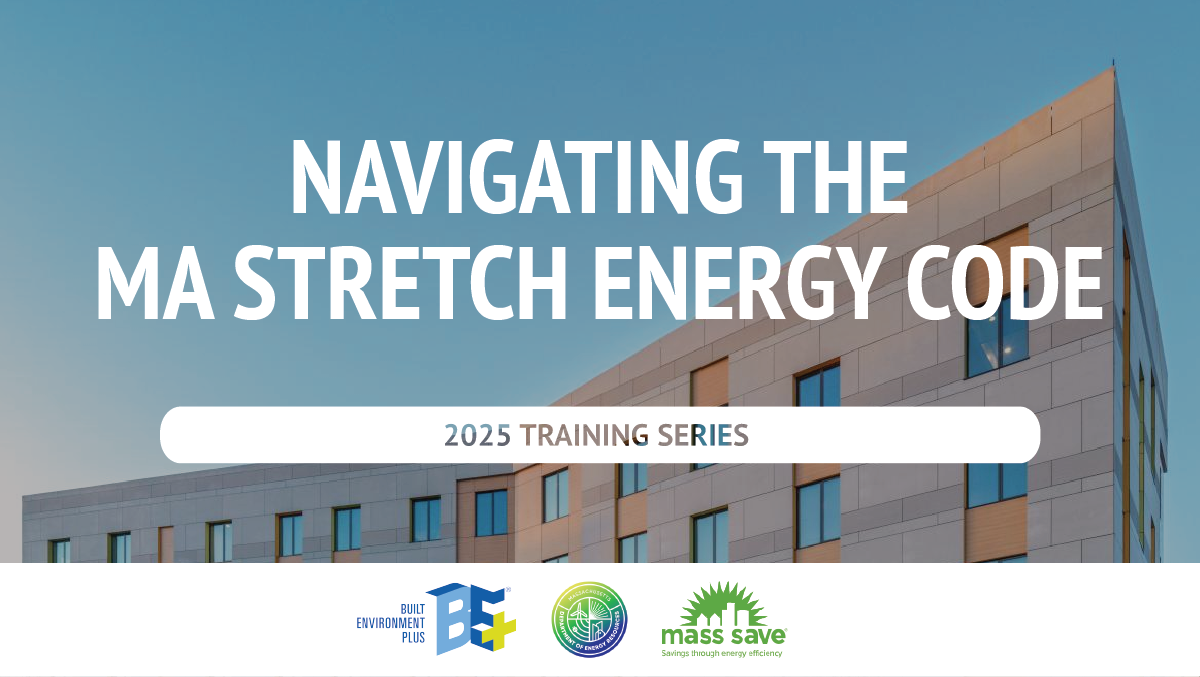
BE+ plays a crucial role in expanding access and building foundational capacity across the AEC industry. In partnership with the DOER and the sponsors of Mass Save, BE+ subsidized over 250 seats in 2025 for the MA Stretch Energy Code Training Series – building on a strong 2024 cohort totaling over 379 unique participants trained across the two series covering the base, stretch, and specialized energy code.

Pre-training surveys showed most attendees were not confident designing or building to code. After completing the training, more than half reported they could do so confidently.

Looking forward to 2026, BE+ is currently in the process of scheduling our education offerings for 2026. We want to hear from learners and educators. Please complete the 2026 BE+ Education Offerings Survey to let us know what topics you are interested in learning about or propose educational content to teach.

BE+ Education

Get in touch with the Education team here

Welcome 2026 BE+ Board of Directors & Honor our Volunteers

Welcome 2026 BE+ Board of Directors & Honor our Volunteers

As we enter 2026, the BE+ community came together at a pivotal time to celebrate the people transforming the built environment. Together, we reflected on a year of meaningful impact, collaboration, and progress. During the Annual Meeting & Volunteer Celebration, we celebrated the achievements of 2025, honored outstanding members and organizations, and officially welcomed new and returning leaders to the BE+ Board of Directors.

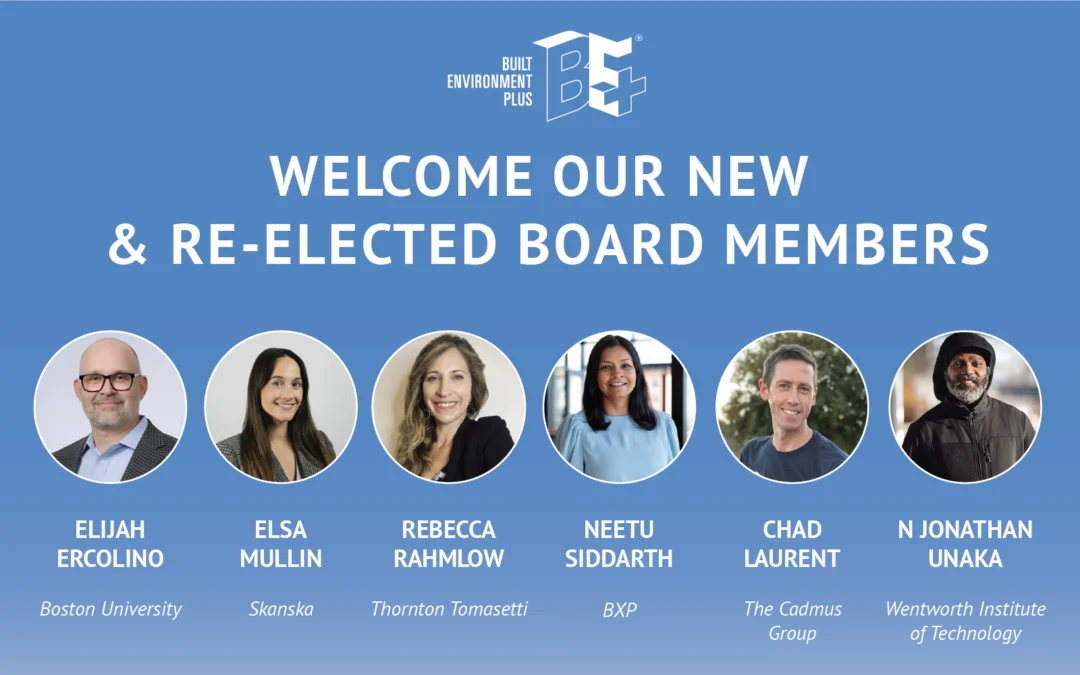
We would like to congratulate and give a warm welcome to Elsa Mullin (Skanska) and Elijah Ercolino (Boston University). We would also like to congratulate the re-elected board members Chad Laurent, Neetu Siddarth, N Jonathan Unaka, and Rebecca Rahmlow.

We also extend our sincere thanks to our departing Board Member Brad Mahoney for his commitment, leadership, and valuable contributions to the BE+ community. In recognition of his contributions, a tree will be planted in honor of him, alongside additional trees in honor of the award recipients.

We’re thrilled to recognize the following individuals and companies for their leadership and commitment:

Company of the Year: Thornton Tomasetti
Net Zero Hero: John Dalzell
Living Future Champion: Jacob Bloom
BE+ Member of the Year: Tammy Ngo
Health & Wellness Champion: Carrie Havey
BE+ Community Leader: Kena David
Emerging Professional of the Year: Cameron Burkacki
Women in Green Warrior: Joytika Bhargo
Education Company of the Year: BH+A

We want to shout out the incredible volunteers that also dedicated their time in making the past year a success! These volunteers showed up with passion and generosity—supporting our events and iniatives that impact the built environment. Check out our volunteers shout outs and see how amazing this community is!

Congratulations to the award recipients, new and returning board members, and everyone continuing their hard work to create a more sustainable and regenerative built environment. Here’s to a year of even more collective impact and progress within the BE+ community and the built environment.