One Boston Wharf Road, Home to 2024 Green Building Showcase

One Boston Wharf Road, Home to 2024 Green Building Showcase

Photo Credits: Boston Seaport by WS

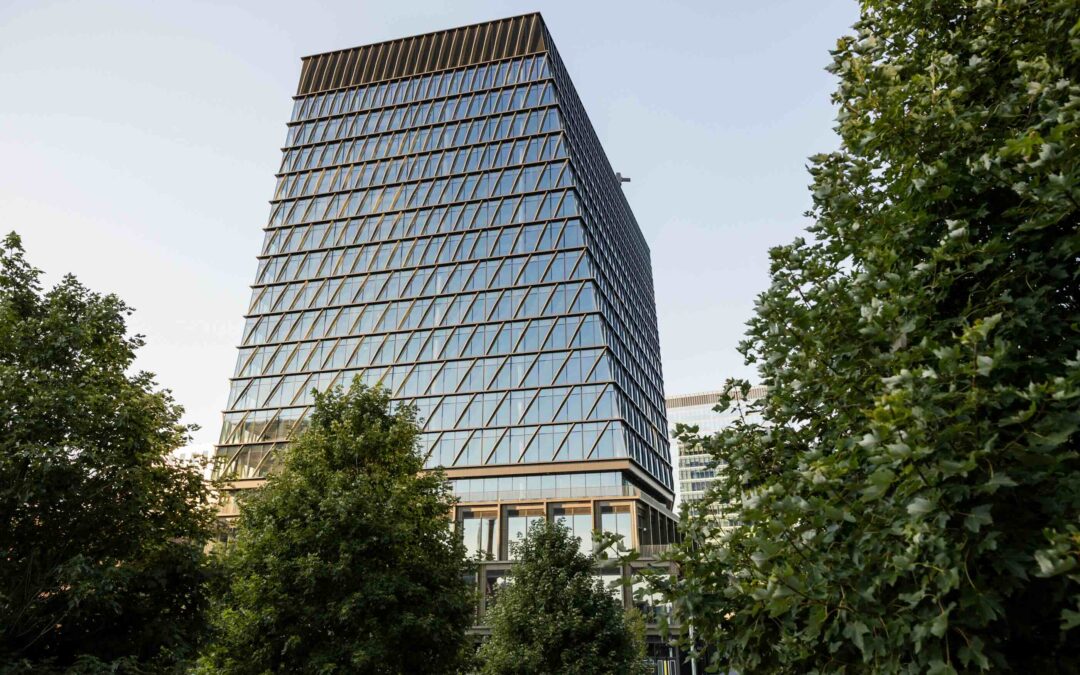
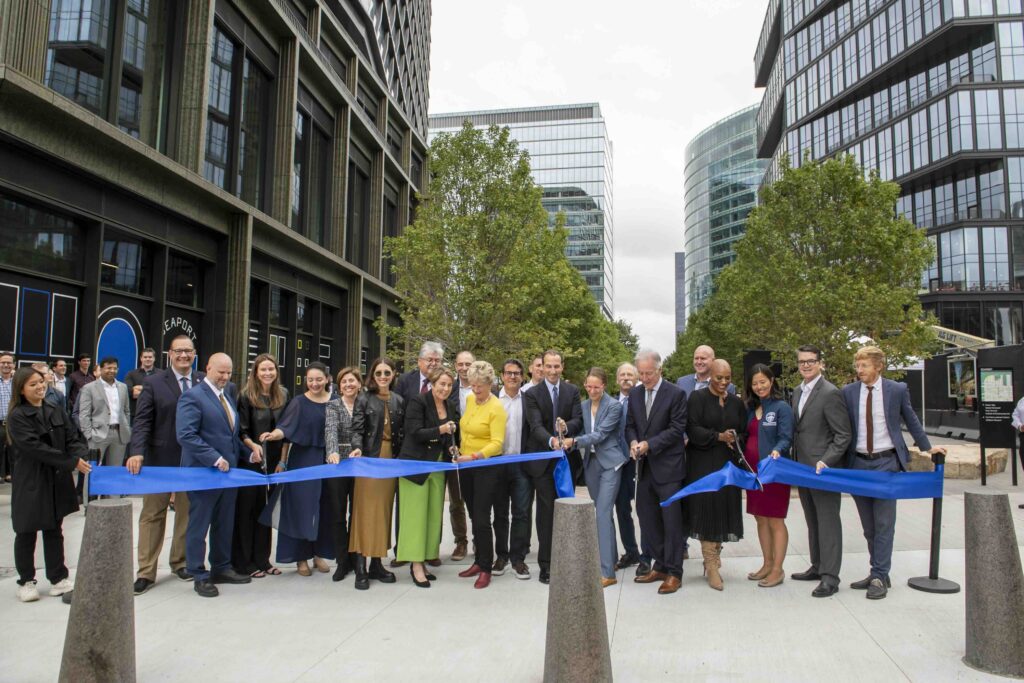
The 2024 Greeen Building Showcase was generously hosted for the second year in a row by WS Development in Boston’s Seaport District. Last year the event was held at the Amazon L4 Tower at 111 Harbor Way. This year we moved across the plaza to the even more exciting L5 project, One Boston Wharf Road, which will be the city’s largest net zero carbon office facility. The following overview of the project was provided by Yanni Tsipis, Senior Vice President – Development at WS Development, who oversees all aspects of the company’s Boston Seaport project, a 33-acre, 20-block, 7.6 million square foot mixed-use development at the heart of the Seaport’s thriving innovation ecosystem.

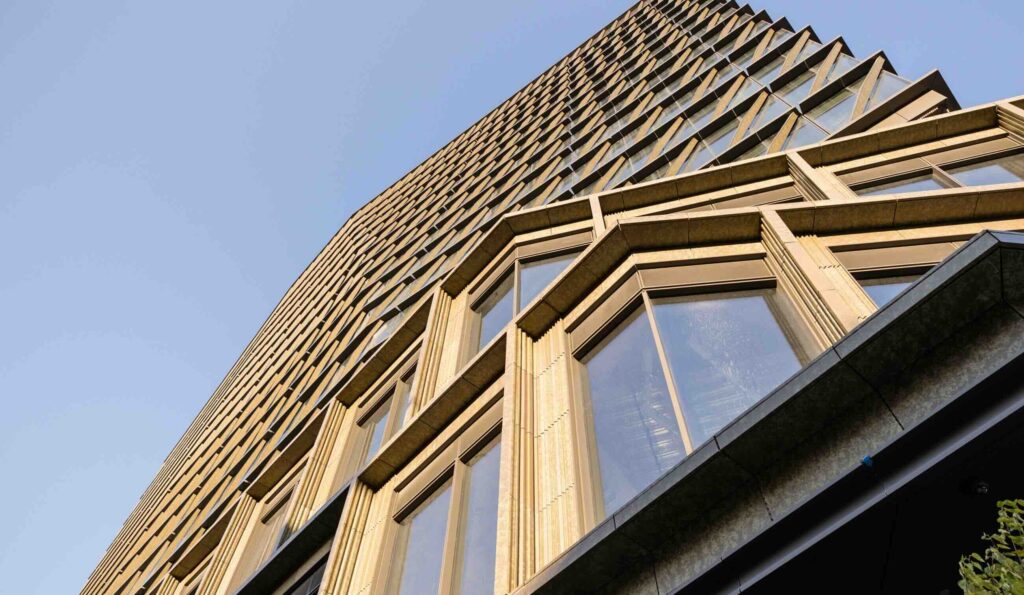
One Boston Wharf Road rises at the entrance to the Boston Seaport district, marking the latest addition to WS Development’s 7.6 million square foot mixed-use project. The building, Boston’s largest net-zero carbon office development, encompasses 700,000 square feet of office, retail, and civic spaces. Designed by Copenhagen-based Henning Larsen Architects in collaboration with Gensler, Buro Happold, The Green Engineer, and McNamara/Salvia, the structure departs from often-seen contemporary glass-box architecture with its distinctively articulated terra cotta facade.
Amazon has fully leased the office space as part of its Boston Tech Hub, which also occupies WS Development’s 111 Harbor Way building (completed 2022).

While the building’s beautiful architecture makes a bold outward statement about our architectural aspirations, its environmental innovations truly distinguish it. The development team committed early to carbon-free operations through an all-electric approach to mechanical systems. This electrification commitment aligns with WS Development’s broader initiative, completed in 2023, to power all of its Seaport assets and much of its New England portfolio with renewable electricity. As part of this strategy, the building employs rooftop air-source heat pumps, advanced energy recovery technology, and state-of-the-art envelope and building management systems.
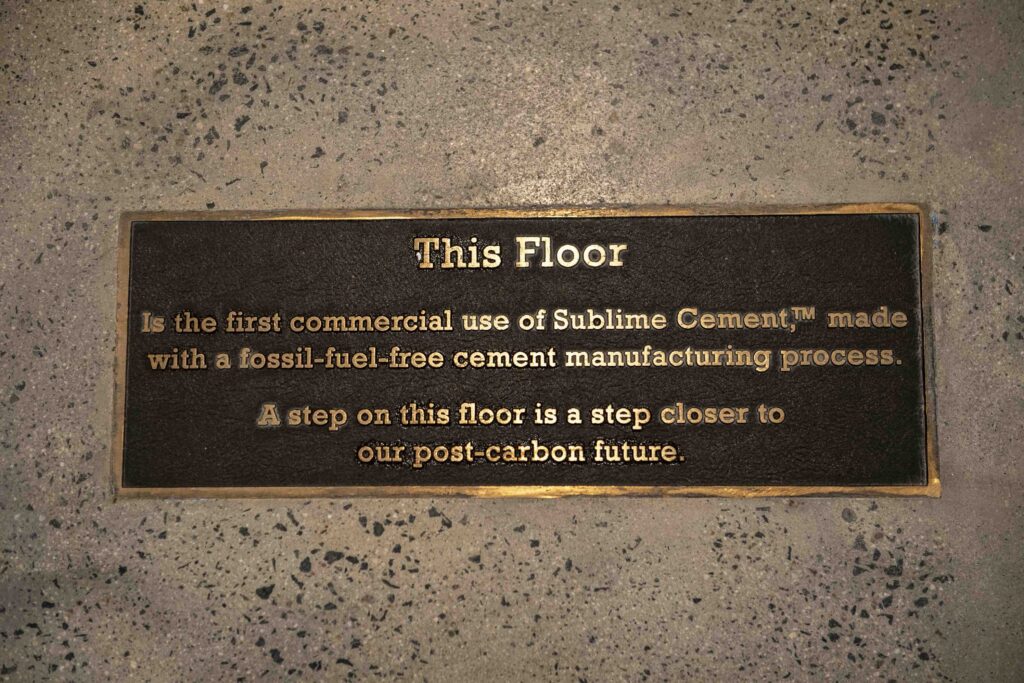
In addition to its commitment to net zero carbon operations, One Boston Wharf Road also pioneers breakthrough construction technology to address embodied carbon as well. The project is the first ever to incorporate Sublime Systems’ innovative cement—a zero-fossil-fuel alternative to Portland cement developed by this MIT spinout company. With Portland cement production accounting for approximately 8% of global fossil fuel emissions, this advancement could transform the construction industry. The building features this revolutionary cement in key public areas, with educational displays highlighting its significance. The ground floor of One Boston Wharf welcomes the public with open spaces that extend to the surrounding outdoor public realm. This accessibility reflects the project’s larger mission: demonstrating how collaborative vision among developers, designers, and innovators can advance carbon-free construction and operations.Sublime Cement plaque - This Floor is the first commercial use of Sublime Cement, made with a fossil-fuel-free cement manufacturing process. A step on this floor is a step closer to our post-carbon future.
Years in the making, One Boston Wharf Road stands as more than a building—it is an aspirational blueprint for sustainable development. Green building enthusiasts and climate innovators are invited to visit and learn more at www.bostonseaport.xyz or @seaportbos.

The Future of LEED – Reflections on a Year on the LEED Steering Committee

By Chris Schaffner

We’re living through difficult times. I hope you and your loved ones are staying safe and healthy, and you can continue to do your good work. Current events are on everyone’s mind, but sustainability remains an important long-term consideration. We are committed to creating a just and sustainable future, and recent events only highlight the need for this work.


In December 2019 I completed my term as chair of the USGBC LEED Steering Committee. I thought I’d spend a few moments to reflect on that experience and discuss the direction that LEED is heading.

I believe we are at an inflection point. The foundations of our work today were laid 25 years or so ago. LEED has brought green building to the forefront and has turned what was the cutting edge into the business as usual. LEED v4.1 has been well-received, but its impact on the market is still pretty small, especially compared to the crisis we face. We must rise to this challenge.

The climate crisis is ever increasing in its urgency. National governments have failed in their obligation to guide the planet to a safe landing. Local governments and NGOs, citizens, people like us, must step into this void.   At the same time economic inequality increases – the gap between rich and poor widens. Those most vulnerable to the effects of a changing climate are also least equipped to deal with the results. 

The green building market is changing rapidly. Calls for energy efficiency have become calls for net zero buildings and decarbonization.  A few years ago, the idea of climate resilience was seen by some as an admission of defeat. Now it’s a key part of green building strategies. Cities like New York are creating rules that will put a real price on carbon. And demand for the elimination of fossil fuel use is growing. For example, Architecture 2030 recently called for a complete ban on fossil fuel use in all new buildings.  We’re transitioning away from the so-called “transition fuels.” It’s 2020, the future is here now. 

We, the members of the USGBC, have an opportunity and an obligation.  LEED addresses the full GHG impact of buildings – not just operational energy, but materials, transportation, water, and waste. But we need to strengthen LEED’s connection to climate, throughout the rating system, and make it more apparent to users. We also must stop sending mixed signals, by using metrics like energy cost rather than GHG emissions. We must embrace and incorporate climate resilience. And we must strengthen the connection between design and operations through recertification, so that a LEED Certification is not just a one-time event, but rather an ongoing process. We must do all these things, and we must do it while increasing LEED’s impact and market share.

Further, while we recognize that human health and social equity are factors in true sustainability, they’ve always been silent partners in LEED – along for the ride but never the focus. This will have to change. 

With these thoughts in mind, here’s where I see LEED heading in the next few years:

  1. Social Equity, Health, and Resilience: The USGBC community will come together this summer through events like the recent Social Equity Summit and the upcoming Healthy Economy Forum to gather ideas and lessons learned from recent events. Some will be whisked straight into LEED v4.1. Others may require more refinement and might wait until the next update.  (Timeline – Summer 2020)
  2. Balloting of LEED v4.1:  LEED v4.1 is still in Beta form, but it has already had a positive impact. Over the next few months the USGBC will use lessons learned from early adopters and will incorporate new lessons from recent events to create a final version to be balloted. Look for balloting to occur around the New Year, with a final version of v4.1 by Spring 2021. (Timeline – early 2021)
  3. Further Incorporation of Carbon, Wellness, Social Equity, and Resilience:  These have become the key issues driving the sustainability discussion today. Over the last 25 years we’ve gone from thinking about buildings’ effects on the environment, to the larger realm of “triple bottom line” sustainability. In the short term expect to see credit intents change to more explicitly highlight a strategy’s impact in these areas as part of the ballot version of v4.1. There is also discussion around creating some kind of recognition for LEED projects that specifically meet goals in social equity, human health, or resilience. For example, “Ten for Equity” would identify ten credits dealing with social equity, and a project that earned all ten might get special recognition.  (Timeline – early 2021, as part of the balloted version.)     
  4. Integration with the Arc Platform and the need for recertification: For years, LEED has struggled with the gap between predictions and performance. It’s time to close this gap. In the future a building will only be considered a LEED building if it can demonstrate performance worthy of the label. The plan is to use Arc to do this. Buildings will first earn LEED Certification in any of the traditional ways – through the New Construction or Existing Buildings Rating systems – but will use Arc to recertify periodically.  Currently recertification for New Construction projects is optional. Watch for it to become mandatory in the near future. (Timeline – no later than end of 2021)    
  5. LEED Positive: At Greenbuild in 2019 USGBC announced the coming of “LEED Positive,” but details of this concept have been sketchy.  It’s a work in progress. Think of it as LEED v5 if you want. The core concept is that we look ahead to 2050 and see where we need to be, and then we design the incremental steps that get us there, imagining an updated LEED every five years. It’s “LEED Positive” because we need to move from a mode reducing negative impacts to creating positive impacts.  As a part of this, we’d set specific minimum requirements for carbon reductions in each iteration, with New Construction projects getting to zero operational carbon very quickly.   (Timeline – More details of LEED Positive and a road map by Fall 2021, LEED v5 by 2025)

These are some of the ideas around the future of LEED. I welcome your feedback, input, and participation in the development of LEED Positive. The consensus process is the real strength of LEED, our secret weapon, and it doesn’t happen without all of you.

One thing we know for sure is that business as usual is not going to cut it. 25 years ago, LEED was a bold vision. It’s time to be bold again. I know we can and will do it, starting here, right now.

About Chris Schaffner

Chris Schaffner, PE, LEED Fellow, is Founder and CEO of The Green Engineer, Inc. a sustainable design consulting firm located in Concord, MA ( and a BE+ Silver Sponsor) . Chris and his firm have completed over 200 LEED Certified projects. He has a long history of volunteering and advocacy for green buildings. He served as a founding board member of USGBC MA, and was chair of the US GBC LEED Steering Committee in 2019. 

Indoor environmental quality and LEED v4

By Taryn Holowka, USGBC National


At Greenbuild 2017, get the info you need on IEQ credits for LEED v4.

At USGBC, we always say that every story about LEED is a story about people. When USGBC set out to create the LEED standards, we wanted to build something that helped people and made their lives better. After all, we spend 90 percent of our time indoors, whether at work, school or home. Knowing this, wouldn’t we want those indoor spaces to be the healthiest and most comfortable places possible?

Better buildings, better productivity

There is also a business case to be made for healthy indoor environments, one that employers, investors, building developers and owners are discovering. A better indoor environment is better for people—and people are the most valuable resource in most organizations, typically accounting for 90 percent of business operating costs. Even a 1 percent improvement in productivity or in reduced absenteeism can have a major impact on the bottom line and competitiveness of any business. A 2012 study found that companies that adopt more rigorous environmental standards are associated with higher labor productivity, by an average of 16 percent, over non-green firms.

LEED has an entire credit category dedicated to the indoor environment: Indoor Environmental Quality (EQ), which includes prerequisites and credits for design and construction projects, interiors, homes and existing buildings.

The EQ credit category in LEED rewards decisions made by projects teams about indoor air quality and thermal, visual and acoustic comfort. Green buildings with high indoor environmental quality protect the health and comfort of building occupants, enhance productivity, decrease absenteeism, improve a building’s value and reduce liability for building designers and owners.

A holistic system for IEQ results

To have a high-quality indoor environment, you need a high-quality building—one that is holistically developed using a system like LEED. You can’t have a high-performing indoor space if the building itself is wasting energy, water and other resources. You can’t ensure health in a building that is constructed on land unsuitable for development. You can’t ensure well-being in a building that is not optimized for the systems inside. You can’t have a more comfortable indoor environment in a building that is contributing to the heat island effect. All of these components contribute to the LEED rating system and what ensures a high-performing building from the inside out.

The relationship between the indoor environment and the health and comfort of occupants is complex. Local customs and expectations, occupant activities and the building’s site, design and construction are just a few variables that make it harder to measure. However, there are many ways to quantify the direct effect of a building on its occupants. LEED balances the need for prescriptive measures with more performance-oriented credit requirements. For example, source control is addressed first in a LEED EQ prerequisite, and a later credit then specifies an indoor air quality assessment to measure the actual outcome of these strategies.

The EQ category also combines traditional approaches with emerging design strategies. Traditional approaches include ventilation and thermal control, while the emerging design techniques involve advanced lighting metrics, acoustics and a holistic emissions-based approach.

Here is the breakdown of the LEED EQ category for existing buildings:

  • Prerequisite: Minimum indoor air quality performance
  • Prerequisite: Environmental Tobacco Smoke Control
  • Prerequisite: Green cleaning policy
  • Credit (2 points); Indoor air quality management program
  • Credit (2 points): Enhanced indoor air quality strategies
  • Credit (1 point): Thermal comfort
  • Credit (2 points): Interior lighting
  • Credit (4 points): Daylight and quality views
  • Credit (1 point): Green cleaning—custodial effectiveness assessment
  • Credit (1 point): Green cleaning—products and materials
  • Credit (1 point): Green cleaning—equipment
  • Credit (2 points): Integrated pest management
  • Credit (1 point): Occupant comfort survey

To learn more about LEED, indoor environmental quality and human health, join us for Greenbuild 2017, being held this year in Boston, India and China.

In Boston, you won't want to miss USGBC’s session D14, dedicated to LEED credit strategies for healthy spaces:

Course: LEED Credit Strategies for Healthy Spaces

Thurs., November 9, 1–2 p.m.

In LEED, the Indoor Environmental Quality category addresses design strategies and environmental factors—such as air quality, lighting quality, acoustic design and control over one’s surroundings—that influence the way people learn, work and live. LEED subject matter experts will review the credits, discuss how teams can prioritize their time and present strategies for implementation.

Register for Greenbuild

The Walden Pond Visitor Center Earns LEED Gold

By USGBC Communications

This month marked the 200th Anniversary of Henry David Thoreau's birthday, and in sync with this anniversary, the new, netzero Walden Pond Visitor Center in Concord, MA has earned LEED Gold Certification.  The new facility will house interactive exhibits on writer, Henry David Thoreau, and a film about Walden Pond.  


The LEED Gold Walden Pond Visitor Center, Concord, MA.

The visitor center – a project that's been 40 years in the making – includes a high-performance exterior envelope; energy-efficient heating and cooling systems; landscaping that mimics the natural habitat, as well as wood grown and processed in Massachusetts. The A/E team anticipates the design will provide a 48% reduction in energy costs and 37% reduction in water consumption compared to baseline building.

The new state-of-the-art Walden Pond Visitor Center welcomes guests from around the world to the state reservation. Walden Pond State Reservation, which is a National Historic Landmark, was made internationally known because of the literary works of naturalist Henry David Thoreau. Thoreau, who wrote ‘Walden; or, Life in the Woods’, which reflects on his time spent over the course of two years, two months, and two days in a cabin he built near Walden Pond, inspired the land conservation movement in the United States. To this day, Walden Pond State Reservation remains a heavily used state park with a popular public swimming beach, as well as other outdoor recreational opportunities such as hiking, boating, and fishing.

The new Walden Pond State Reservation Visitor Center features:

  • 5,680 net square feet, approximately two-thirds of which will be dedicated to publicly available interpretive displays related to the life and legacy of Henry David Thoreau;
  • A south-facing orientation providing a wood and glass façade to maximize solar efficiency;
  • Superinsulation with increased roof, wall, and window values to conserve energy;
  • A 9 kilowatt (kW) solar hot water system;
  • A Variable Refrigerant Flow heat pump system;
  • A low flow plumbing system to reduce water consumption; and,
  • A 100 kW solar canopy array in an adjacent parking lot that will generate more than enough clean renewable power over the course of a year for the visitor center.

Congratulations, The Green Engineer (USGBC MA Chapter Sponsor), on the achievements of this wonderful project!

Materials strategies in LEED v4

By Selina Holmes, USGBC National


At Greenbuild 2017, get the info you need on materials credits for LEED v4.

The topic of materials is one that spans every phase of a building’s life cycle. It includes considerations about construction waste, specifying materials for the building’s structure in the design and construction phase, making green cleaning choices while the building is in use and determining what happens to the building in the demolition phase.

Quick facts about construction waste:

  • Construction and demolition waste constitutes about 40 percent of the total solid waste stream in the United States and about 25 percent of the total waste stream in the European Union.
  • In aggregate, LEED projects are responsible for diverting more than 80 million tons of waste from landfills, and this volume is expected to grow to 540 million tons by 2030.

Materials decisions are impacted by an array of stakeholders who work with the built environment and those who support it, as well as by those who work, learn, live and play within those buildings.


LEED projects divert more than 80 million tons of waste from landfills


What LEED does with materials

Since its initial launch, LEED has always addressed materials, and the newest version of the rating system is no different. LEED v4 brings a shift that goes beyond materials decisions focusing on single attributes and moves the market toward conversations about optimizing environmental, social and health impacts and gaining a better understanding of the trade-offs.

The LEED Building Design and Construction materials credits and prerequisites include:

  • Prerequisite: Storage and Collection of Recyclables
  • Prerequisite: Construction and Demolition Waste Management Planning
  • Prerequisite: PBT Source Reduction—Mercury
  • Credit (5–6 points): Building Life-Cycle Impact Reduction
  • Credit (2 points): Building Product Disclosure and Optimization—Environmental Product Declarations
  • Credit (2 points): Building Product Disclosure and Optimization—Sourcing of Raw Materials
  • Credit (2 points): Building Product Disclosure and Optimization—Material Ingredients
  • Credit (1 point): PBT Source Reduction—Mercury
  • Credit (2 points): PBT Source Reduction—Lead, Cadmium and Copper
  • Credit (2 points): Furniture and Medical Furnishings
  • Credit (1 point): Design for Flexibility
  • Credit (2 points): Construction and Demolition Waste Management

The LEED Operations and Maintenance materials credits and prerequisites include:

  • Prerequisite: Ongoing Purchasing and Waste Policy
  • Prerequisite: Facility Maintenance and Renovation Policy       
  • Credit (1 point): Purchasing—Ongoing           
  • Credit (1 point): Purchasing—Lamps  
  • Credit (2 points): Purchasing—Facility Management and Renovation
  • Credit (2 points): Solid Waste Management—Ongoing
  • Credit (2 points): Solid Waste Management—Facility Maintenance and Renovation

Join USGBC at Greenbuild 2017 in Boston, India and China, to learn more about LEED and materials. In addition to educations sessions, Greenbuild in Boston and India will feature expo halls where attendees can interact with the newest and most innovative products the market has to offer.

The Boston Greenbuild event will also include a special session on LEED v4 and its materials and resources section:

Course: LEED v4 and Materials: Interactive Session

Thurs., November 9 from 5–6 p.m.

During this session, attendees will get an overview of the LEED v4 materials section, learning what has changed, what’s been added and how to implement key strategies, including reading and comparing EPDs.

Register for Greenbuild Boston