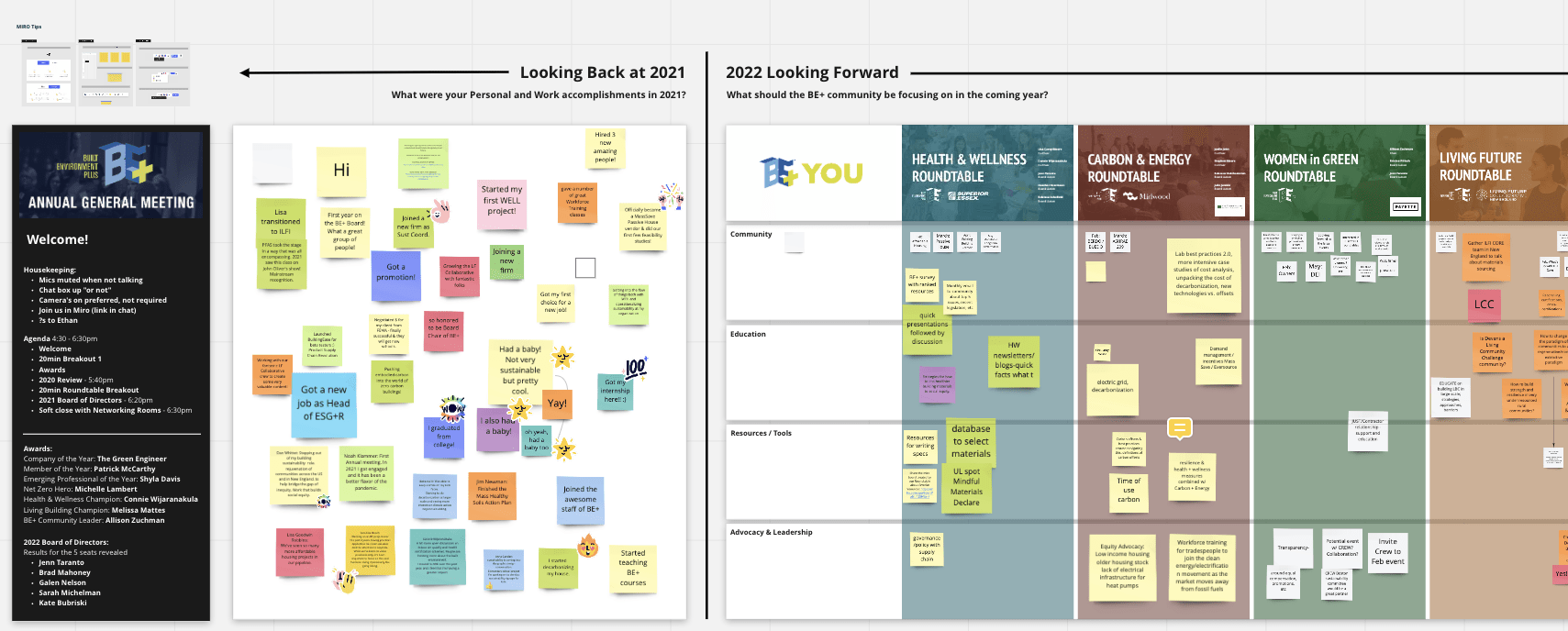
BE+ members gathered virtually January 27th for our 14th Annual General Meeting, and just our second as Built Environment Plus. While we look forward to in-person gatherings in the future, it was great to see new and familiar faces and collaborative participation through Zoom and Miro.
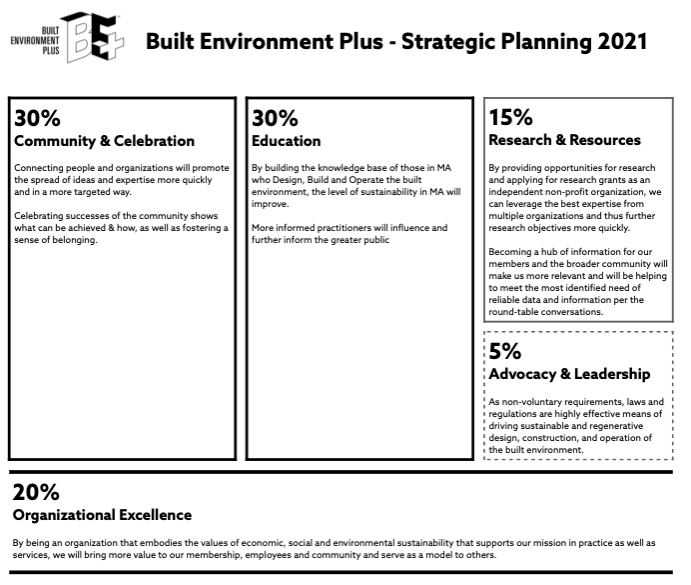
We looked back on a remarkable year, got a sneak peak of the 2021 Annual Report, and plunged forward on bringing the 2021 strategic plan to life in 2022. We also announced the results of our 2022 Board of Directors election.
Congratulations to our 2021 Award Winners
Company of the Year: The Green Engineer
Net Zero Hero: Michelle Lambert
Living Building Champion: Melissa Mattes
Member of the Year: Patrick McCarthy
Health and Wellness Champion: Connie Wijaranakula
BE+ Community Leader: Allison Zuchman
Emerging Professional of the Year: Shyla Davis
Thank You to Our Departing BE+ Board Members
Lindsey Machamer
Michael Chavez
Kimberly Cullinane
Barbra BatShalom
Trees to be planted in their honor.
We were very excited to announce the Barbra BatShalom Scholarship to honor Barbra’s stalwart leadership. The scholarship will provide equitable access to BE+ programming for a community member who embodies Barbra’s visionary impulse.
Returning Board Members
Jana Silsby
Chair Emeritus
Jenn Taranto
Contractor Board Seat Re-elected
Brad Mahoney
Incumbent Candidate Re-elected
Galen Nelson
Incumbent Candidate Re-elected
Welcome New BE+ Board Members
Kate Bubriski
Arrowstreet
Sarah Michelman
The Green Engineer
Kiersten Washle
CMTA, Emerging Professionals Representative
They join the continuing directors Randa Ghattas, Rebecca Hatchadorian, Heather Henriksen, Michael Fiorillo, Kristen Fritsch, Julie Janiski, Brad Mahoney, Galen Nelson, Rebecca Schofield, Jana Silsby, Jim Stanislaski, and Jenn Taranto.
Accelerating Change in the Built Environment, Together
As usual, we are blown away by the talent, passion, vision, and commitment of the BE+ community to reshape the built environment so that it truly serves us. It’s important for us to take stock of how far the green building community has come as we strategically consider our evolving role in advancing the triple bottom line of sustainability in the built environment. We look forward to working with our 2022 Board of Directors, our mighty community of practitioners, emerging leaders in the field, and a growing ecosystem of stakeholders seeking win-win-win collaboration.
If you’re just as inspired to plug into an exciting new year, jump into the meeting’s Miro board below!
On Tuesday February 23rd, the USGBC MA Chapter hosted an in depth discussion and tour of the LEED Platinum, Commonwealth of Massachusetts Division of Fisheries & Wildlife Headquarters located in Westboro, Massachusetts, winner of the Chapter's 2015 Innovation in Green Design Award. Designed for net zero energy performance with direction from the Division of Capital Asset Management and completed in early 2015, the facility is on-track to meet and perhaps exceed its performance goal in 2016, according to Conor McGuire, Director of Sustainability at Columbia Construction Company. The project was designed to be the first publicly owned net zero energy building in the Commonwealth. Conor was joined by Dan Arons, Principal Architect for Architerra, Inc. who was responsible for design of the project. They report the facility was 94% efficient in first year of operation. Record breaking snow accumulation and cold temperatures in February of 2015 reduced the energy output of the rooftop photovoltaic array to below expected levels; however the overall annual performance suggests the facility may even be net positive in 2016.
Located on a beautiful cleared and gently sloping hilltop site overlooking a wildlife management area at the edge of the former Lyman School campus, the two story building responds to the horizon with the long side oriented on the east-west axis for maximum solar exposure. The sloping shed roof is covered by an impressive 300 kW photovoltaic panel array. A deep overhang on the south facing façade provides shading for interior spaces from high angle sun in the summer months, reducing solar heat gain during the cooling season, but allows low angle winter sun to penetrate the interior to offset the heat load during the heating season. North facing clerestory windows allow daylight to penetrate the interior, reducing the energy required for artificial illumination through daylight sensors and controls, which regulate interior lighting levels based on the available daylight. Vacancy sensors were chosen for daylit spaces to avoid turning lights on unnecessarily. Unlike an occupancy sensor, a vacancy sensor requires the room occupant to turn the lighting on manually when entering the space, then turns the lights off automatically after the occupant leaves. When adequate daylight is available, the occupant is less likely to turn the lights on.
The exterior walls and roof are constructed of structural insulated panels (SIPs), a layer of foam plastic insulation with oriented strand board bonded to both sides. When compared to framed wall and roof assemblies, SIPs allow for continuous insulation uninterrupted by framing members, maximizing the insulating value in a minimum depth. A continuous air and weather barrier was applied over the SIPs behind open joint rain screen panels. Maintaining the continuity of the air barrier is critically important to the thermal performance of the building envelope. Whole building blower door testing confirmed the building's air barrier performed at an average leakage rate of .062 cfm/ft² at 75 Pa, far exceeding the minimum energy code performance value for building tested assemblies (0.40 cfm/ft²). The open joint rain screen design allows for bulk water to penetrate the cladding and drain down the face of the weather barrier in the air cavity behind. Ventilating the cavity promotes air circulation and drying which increases the overall resilience of the wall assembly.
In addition to passive design measures, the project utilizes highly efficient environmental systems to drive down the Energy Use Intensity (EUI) which is a measure of the energy consumed annually per square foot at the site. The design and engineering team targeted a low EUI (26.3KBtu/ft²/yr) which could be offset by the renewable energy production available from the photovoltaic array, resulting in a balance of energy consumed with energy produced on site. The building's primary systems are all electric, which eliminates on-site combustion of fossil fuels and carbon emissions.
The key strategy employed by the team for reducing the EUI includes separating the heating and cooling systems from ventilation air through the use of a dedicated outdoor air system (DOAS) and low temperature hydronic radiant floor and ceiling panels. Compared to air delivery systems, a low temperature differential between heating and cooling modes is possible when radiant energy is utilized to maintain thermal comfort. Further, the pump energy required for hydronic systems is significantly less than the fan power required for air systems to deliver heating and cooling. Hydronic systems become more increasingly more efficient than air systems as the size of the building increases. The low temperature differential is supported by a ground source heat pump system with 20 closed loop wells by transferring the thermal energy of the ground beneath the site, which is at near constant temperature year round, to the building's heating and cooling systems. 'Free cooling' is available during the swing seasons via bypassing the heat pump compression cycle and running the cooling tower.
The energy required to meet the ASHRAE 62.1 ventilation standard required for LEED certification is offset by the dedicated outdoor air system. Latent load, which is the energy required to remove moisture from air without change in temperature, is decoupled from the sensible load, which is the energy required to raise or lower the air temperature, by dehumidifying the ventilation air. The thermal energy of the air returned from the interior spaces is exchanged with the incoming ventilation air by an energy recovery ventilator (ERV). The entire latent load and a portion of the sensible load are taken by the DOAS, while the hydronic radiant system handles the balance of the sensible load. The overall result of running the two systems in parallel is a highly energy efficient solution that provides superior thermal comfort for the occupants.
Thank you to Conor, Dan and the staff at the Division of Fisheries & Wildlife for leading the in-depth discussion and tour of this skillfully designed, engineered and constructed net zero energy facility.
This March, in just a few weeks, the USGBC MA chapter will be hosting a special COP21 Paris Climate Talks Unconference to revisit these important international conversations.
This is a unique opportunity to discuss the historic 2015 United Nations Congress of the Parties (COP21), held this past December in Paris, France. The provisions and commitments reached in the agreement have global implications for sustainability, climate change, and green building, and certainly warrant a closer examination, extensive analysis, and more discussion.
For this reason, we have put together a half-day event featuring a community of experts from a variety of organzations and firms. Panelists who attended the Paris climate talks will be present, with break-out groups led by local issue experts.
Michael Green, Climate Action Business Association
Christopher Mackey, Payette
Professor John Sterman, MIT System Dynamics Group
Our unConference Discussion Leaders:
Josh Craft, Environmental League of Massachusetts
Henrietta Davis, former Mayor of the City of Cambridge
Elizabeth Saunders, Clean Water Action
More about the Event:
More than 30 per cent of global greenhouse gas emissions are buildings-related, and emissions could double by 2050 if we carry on business as usual. Inaction increases risks and vulnerability of countries, regions and local communities from climate change. Yet:
The buildings sector offers one of the most cost-effective and economically beneficial paths for reducing energy demand and associated emissions while at the same time supporting adaptation and resilience to climate change.
Many low-energy, renewable and deep- renovation solutions are available. Proven policy, finance and technology actions exist.
The economic, health, and social benefits of sustainable buildings are significant. Buildings provide shelter, places to live, work, learn and socialize, directly affecting our daily lives.
Buildings are long-term ventures. Today’s new buildings are tomorrow’s existing stock. Failure to act now will lock in growth in GHG emissions for decades.
Here is how the morning will pan out:
8:30 – 9 Registration and networking
9 – 9:15 Keynote and opening
9:15 – 10:30 Breakout (unconference)
10:30 – 10:40 Break + Networking
10:40 – 12:00 Paris Panel with questions from audience
Both the panel and breakout sessions will focus on the following topics and will provide perspectives from various professional backgrounds:
Value Chain Transformation: is the building sector capable of massive deployment of low emitting buildings and deep renovations? How will building sector stakeholders better work together to scale up solutions adapted to local circumstances?
Bridging the investment gap: how ready is the finance sector to increase investment in building efficiency? How will we address the critical need to scale up the public and private financing of EE and sustainable buildings. We will explore how buildings and EE can contribute to realizing MA's carbon goals and how the financial sector can help support that.
Public Policies: what is the readiness to implement long term action plans to address the key role of local jurisdictions to organize and facilitate integrated policy packages and collaborative approaches that shift to a low carbon and resilient built environment.
Building rating & reporting systems: how do they support the COP21 momentum?
Please join us as a community of advocates and practitioners as we explore how to leverage the public awareness and policy momentum generated by COP21 to drive policy gains in Massachusetts.
Are you passionate about sustainability, efficiency, and the environment? Do you have familiarity with green building and understand how the built environment affects all of us and the world?
If yes, then you should consider joining our volunteers! We have a variety of open positions with different responsibilities, qualifications, and time commitments, and all positions receive some kind of benefit!
With any of the volunteer positions, you will be an integral component of our operations and gain a greater understanding of our organization, its mission and its goals, and how we organize our events, advocate, and conduct outreach.
Each position has its own details and specifics, but with any of these opportunities you will get to know the ins-and-outs of our organization, green building, and more!
If you're interested, you can learn more from our volunteer page or fill out our volunteering questionaire form. We are very flexible with time commitment, the window of time in which you would want to volunteer, and prior experiences and qualifications.
Volunteering with the Chapter will qualify for credential maintenance hours for GBCI – up to half of your required hours can be earned through volunteering with us. Usually this is much more engaging than sitting through a webinar late at night!
Are you passionate about sustainability, efficiency, and the environment? Do you have familiarity with green building and understand how the built environment affects all of us and the world?
If yes, then you should consider joining our volunteers! We have a variety of open positions with different responsibilities, qualifications, and time commitments, and all positions receive some kind of benefit!
With any of the volunteer positions, you will be an integral component of our operations and gain a greater understanding of our organization, its mission and its goals, and how we organize our events, advocate, and conduct outreach.
Each position has its own details and specifics, but with any of these opportunities you will get to know the ins-and-outs of our organization, green building, and more!
If you're interested, you can learn more from our volunteer page or fill out our volunteering questionaire form. We are very flexible with time commitment, the window of time in which you would want to volunteer, and prior experiences and qualifications.