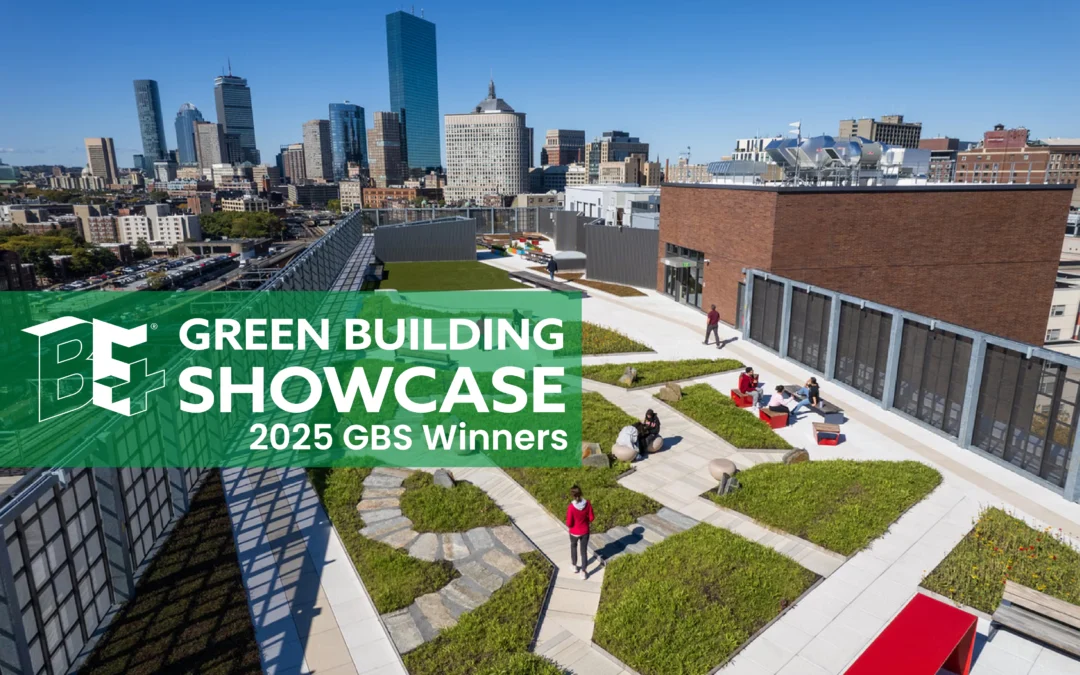
Massachusetts green building leaders celebrate innovation and impact
Built Environment Plus was thrilled to host another record-breaking Green Building Showcase at Boston’s largest net-zero facility at One Boston Wharf Road. Over 330 people gathered to celebrate the local green building community and the accelerating progress towards sustainable and regenerative buildings across Massachusetts.
We received a record of 68 award submissions this year, including nine for a new Building Decarb Intervention Award focused on smaller-scale emission reduction interventions for existing buildings. The outstanding projects reflected the growing pace of market transformation led by policy, practice, and shifting priorities.
WS Development generously hosted the event for the third consecutive year, showcasing the ongoing transformation of the Seaport neighborhood.
A panel of national judges selected the standout projects, while local judges chose a Change Agent of the Year recognizing someone making a significant positive impact on the environment, social equity, and the economy.
GREEN BUILDING OF THE YEAR & PEOPLE’S CHOICE AWARD WINNER!
Josiah Quincy Upper School
Submitted by HMFH Architects
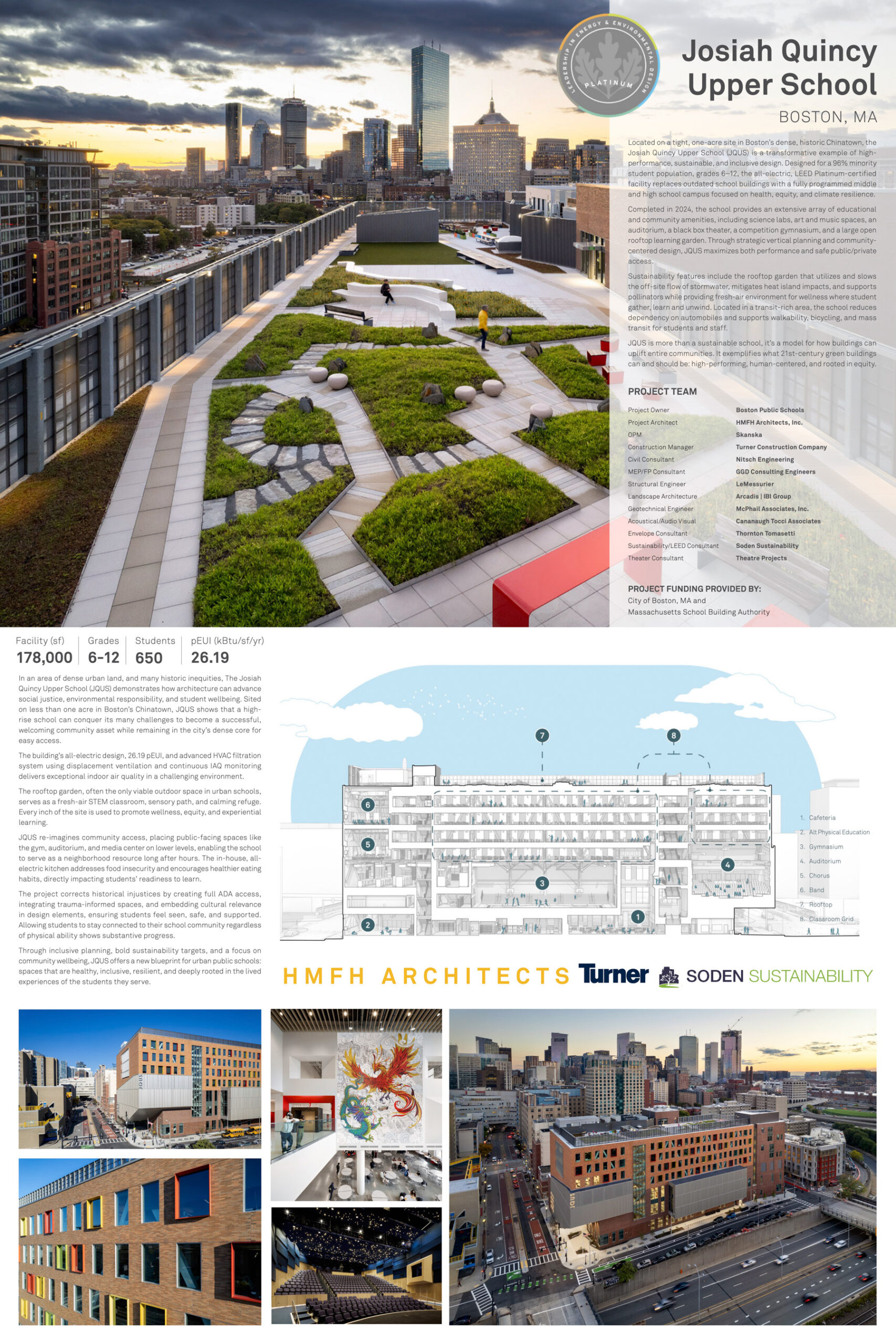
The Josiah Quincy Upper School (JQUS), located in Boston’s historic Chinatown, is designed to meet Boston’s Green New Deal and climate action plans, support minority students in a dense urban environment, and provide all of the educational facilities of a modern high school. The all-electric facility is one of only eight schools nation-wide to receive a LEED v4.1 Platinum certification, and demonstrates how sustainable performance and educational excellence can be achieved in dense, urban conditions, on small sites, and economically.
Health equity was a central priority for JQUS. A university study showed that the Chinatown site was heavily plagued by low-lying pollution from the adjacent major highways and railroad corridors. Indoor air quality is assured by bringing filtered fresh air in from high upon the rooftop where these vehicular pollutants are less dense. The expansive rooftop garden provides outdoor classrooms, sensory walking paths, and calming spaces for students. The Josiah Quincy Upper School (JQUS) demonstrates how architecture can advance social justice, environmental responsibility, and student wellbeing.
JQUS reimagines community access by placing public-facing spaces like the gym, auditorium, and media center on lower levels, enabling the school to serve as a neighborhood resource long after hours. Through inclusive planning, bold sustainability targets, and a focus on community wellbeing, JQUS offers a new blueprint for urban public schools: spaces that are healthy, inclusive, resilient, and deeply rooted in the lived experiences of the students they serve.
According to the judges, “This project does the most with the least. It supports the whole learner, addresses a broad set of sustainability issues, and fully leverages a challenging site and limited budget for maximum impact in an underserved community.”
This inpsiring project was also a fan favorite, capturing the 2025 Green Building Showcase People’s Choice Award!
BUILDING DECARB INTERVENTION
Roxbury Tenants of Harvard Levinson Heat Recovery
Submitted by GreenerU, Inc.
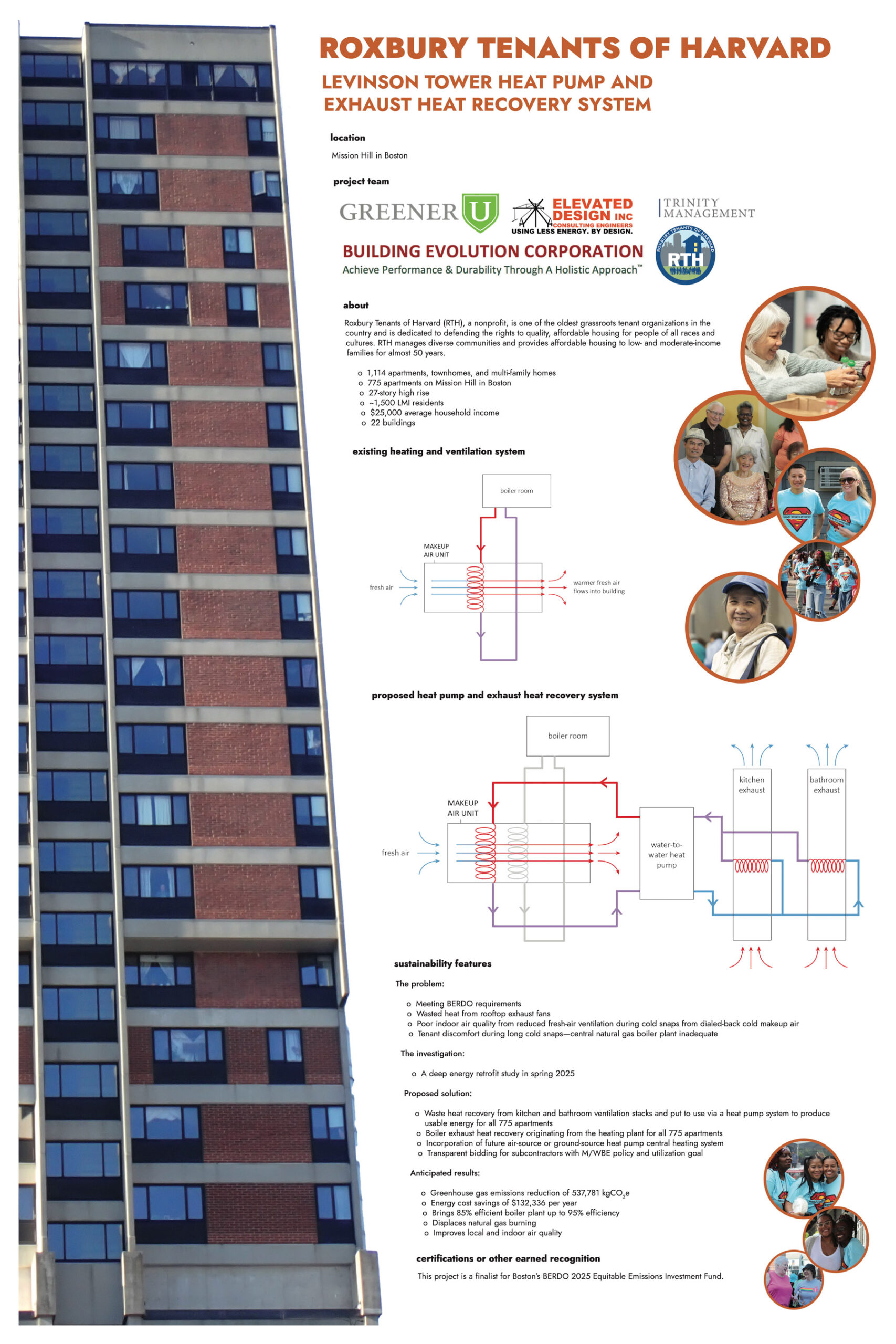
Located in Boston’s Mission Hill neighborhood, the Mission Park is one of Boston’s largest affordable housing communities, with 775 apartment units across mid- and high-rise towers and townhomes. At its center, the Levinson tower houses the most apartment units along with the campus’s central heating plant.
The Levinson Heat Recovery Project introduces an innovative retrofit to this 27-story tower, installing roof-mounted heat pumps and exhaust recovery units that capture low-grade thermal energy from kitchen and bathroom exhaust stacks. This recovered heat is transferred to the building’s make-up air unit, reducing the overall heating load and immediately cutting site greenhouse gas emissions. The project will provide immediate reduction in site GHG emissions, improve BERDO compliance position for RTH, improve thermal and environmental quality for residents, and support the local clean technology economy.
This project provides an innovative approach to retrofitting the energy systems of this urban community setting and making significant reduction in greenhouse gas emissions without disruption to residents. Aspects of the design approach depend on certain building specifics, but can apply to other similar buildings and campuses, especially larger multifamily and educational sites. This project models one way of finding opportunities for significant energy and emissions reduction through comprehensive planning and creative engineering design.
According to the judges, “The renovation at Levinson is designed to improve the health of low-income residents, reduce heating costs, and capture wasted heat while providing significant decarbonization and compatibility with a future ground source heat pump. The jury was also impressed at the number of stakeholders engaged in the process. We need this kind of creativity and work at scale!”
The judges added an honorable mention to the Hano Homes Deep Energy Retrofit submitted by Sustainable Comfort. They said, “This exemplary deep energy retrofit of 20 affordable housing units features low embodied carbon materials and full electrification. Limited impact on existing tenants and the common typology makes this approach very replicable.”
CARBON & ENERGY
The Guild
Submitted by Utile
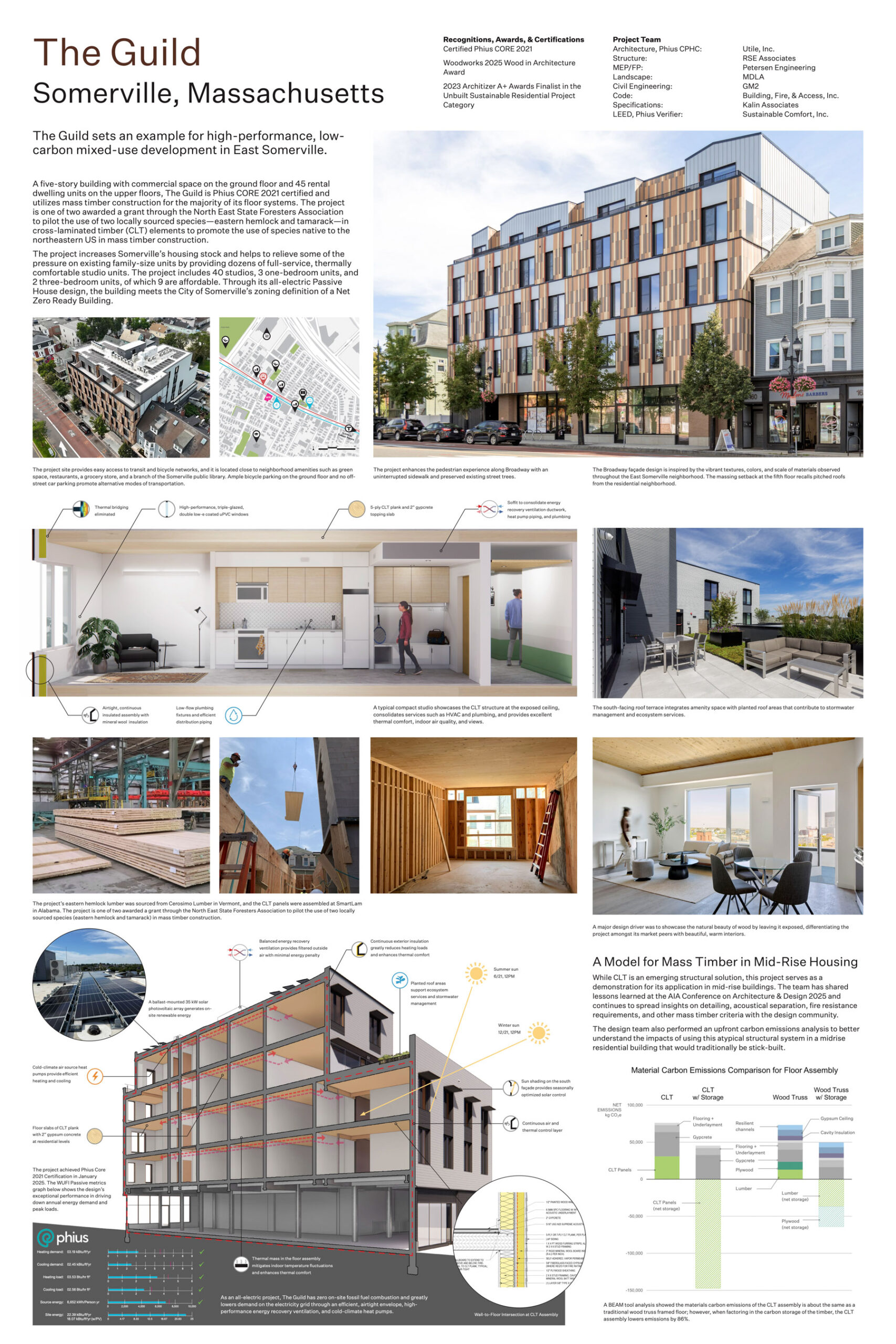
The Guild sets an example for high-performance, low-carbon mixed-use development in Somerville, MA. A five-story building with commercial space on the ground floor and 45 rental dwelling units on the upper floors, the project has achieved Passive House certification through the Phius CORE 2021 standard and utilizes mass timber construction for the majority of its floor systems.
The Guild was a pilot project for the use of cross laminated timber (CLT) construction, specifically for the innovative use of locally-sourced eastern hemlock and tamarack from New England. The project features CLT planks as structural elements for the four residential stories, demonstrating the potential for alternative, low-embodied carbon structural materials for multi-family housing.
This market-rate Passive House project went against the grain through a combination of factors, including Somerville’s progressive Net Zero Ready zoning policy, a forward-thinking developer, and an experienced design team with in-house energy modeling expertise. As a result, the project is an early adopter for market-rate Passive House developments in Somerville and one of the few in the Greater Boston area.
The all-electric project will have zero on-site fossil fuel combustion, and, through its Passive House design, greatly lowers demand on the electricity grid through an efficient, airtight envelope, high-performance energy recovery ventilation, and cold-climate heat pumps.
According to the judges, “The Guild masterfully reduces operational carbon through its highly efficient, all-electric design that minimizes energy use while prioritizing occupant comfort by leveraging PHIUS design principles. This is balanced by an aggressive focus on embodied carbon reduction by embracing mass timber construction and thoughtful use of materials. The project’s execution, replicable mid-rise model, and pragmatic design make it a standout example of context-sensitive, sustainable development.”
The judges also extended an honorable mention to the UMass Computer Science Laboratories Addition submitted by Perkins Eastman, saying, “The project is notable for its thoughtful design balancing both embodied carbon and operational carbon reduction strategies. The submission graphics provide a clear understanding of the selected design measures – both architecture and building systems – with associated carbon reduction metrics well defined.”
HEALTH & WELLNESS
Penn State Behrend Erie Hall Recreation and Wellness Center
Submitted by Sasaki
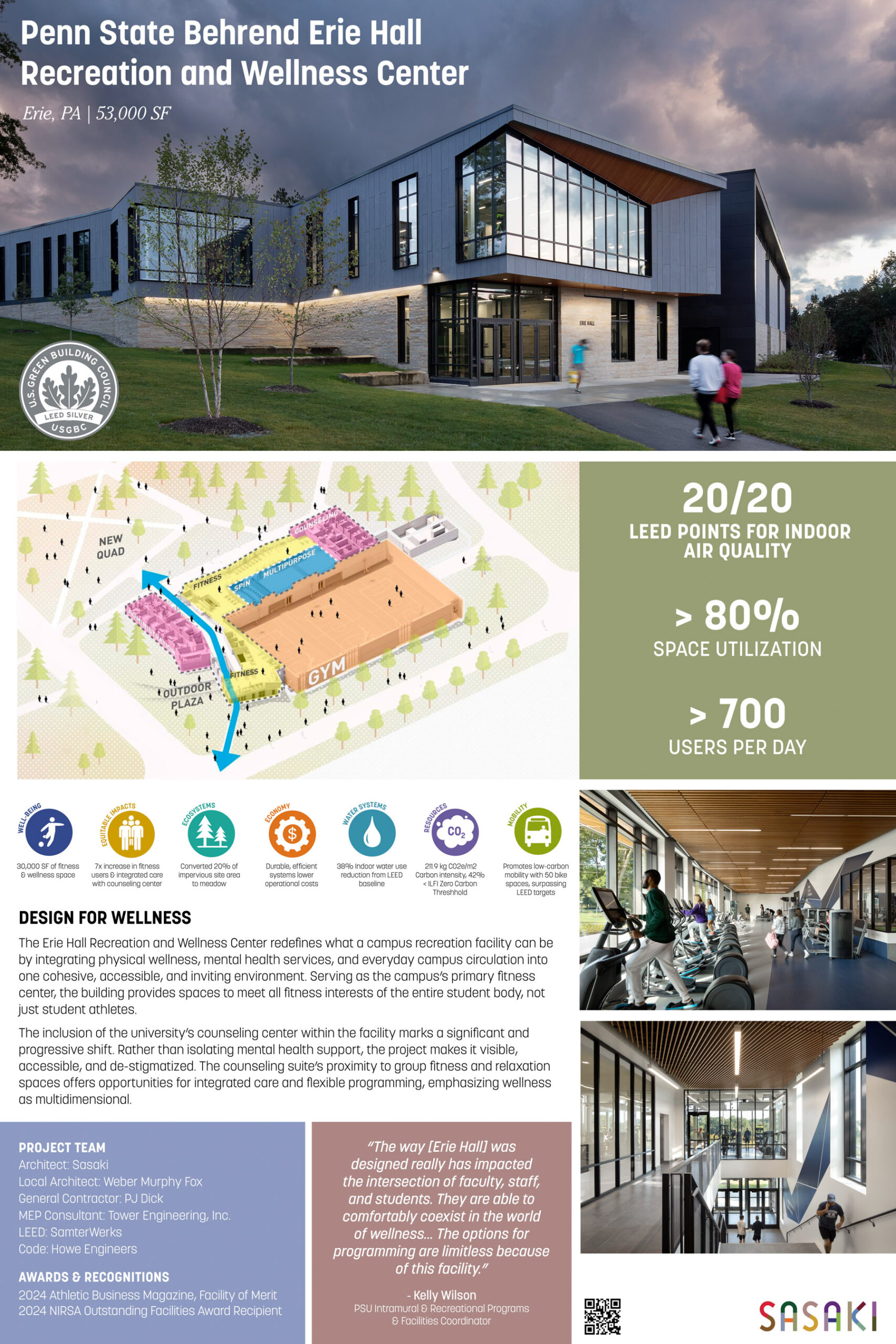
The Erie Hall Recreation and Wellness Center is a transformational facility at Penn State Behrend that merges physical recreation with mental health support in a dynamic, highly visible location at the heart of campus. Replacing the outdated Erie Hall gym, the new center achieved LEED Silver certification in 2023, and serves as both a student destination and a critical pedestrian connector, establishing a gateway to the campus core.
The Erie Hall Recreation and Wellness Center redefines what a campus recreation facility can be by integrating physical wellness, mental health services, and everyday campus circulation into one cohesive, accessible, and inviting environment. Its innovation lies not only in what program spaces it includes, like recreation courts, fitness neighborhoods, and a counseling center, but in how these elements are intentionally brought together to support holistic student well-being, demonstrating how thoughtful, inclusive design can transform the way communities engage with wellness. By decentralizing fitness opportunities and embedding them within everyday campus life, the design promotes accessibility and normalizes wellness as part of daily routine.
The co-location of recreational fitness and counseling services within a single facility signals a progressive, holistic view of health that can serve as a model for institutions nationwide. This integrated approach encourages students to see physical and mental wellness as interconnected and equally valued.
Architecturally, the building design offers an innovative response to topography. The sloped site is leveraged to embed spaces that benefit from enclosure, such as wrestling and locker rooms, while elevating active, light-filled areas to overlook the future campus quad. A sculptural canopy shades major façades, enhancing comfort and energy performance, while also creating a strong visual identity at the southern gateway to campus.
According to the judges, “Penn State Behrend Erie Hall has reimagined how the design of a campus wellness facility can support both physiological and psychological health within a unified, student-centered space. The design stood out for making health resources more approachable and embedding them into the daily rhythm of campus life.”
EQUITY & INCLUSION
The Pryde
Submitted by DiMella Shaffer

The Pryde transforms the historic William Barton Rogers Middle School in Hyde Park—vacant since 2015—into 74 units of affordable housing for LGBTQ+ seniors and a vibrant community center serving residents and neighbors. Blending historic preservation with all-electric, high-performance design, the project offers a replicable model for turning vacant schools into inclusive, resilient housing.
The project preserves the school’s iconic façades and interior details, converting classrooms into light-filled apartments and shared spaces, including a courtyard, art gallery, library, and multipurpose event room. Over 400 letters of community support during the public RFP process helped shape programming that fosters safety, connection, and intergenerational engagement.
Working with the Massachusetts Historical Commission and National Park Service, the team balanced preservation with energy efficiency through electric systems, high insulation, and historic replacement windows. The project achieved Fitwel certification and won the 2024 Best in Building Health Award, earning the highest score under Fitwel’s new senior housing scorecard. By reusing over 80% of the existing structure, The Pryde reduced embodied carbon by more than 40%.
As New England’s first LGBTQ+-friendly affordable senior community, The Pryde fills a critical housing gap while strengthening neighborhood ties.
According to the judges, “The Pryde redefines inclusive housing through the adaptive reuse of a historic school into New England’s first LGBTQ+ affordable senior community. Its design goes beyond accessibility to foster belonging, dignity, and resilience, essentially turning history into hope+national precedent and architecture into advocacy.”
SITE & LANDSCAPE
J.J. Carroll Redevelopment’s Intergenerational Gardens
Submitted by Stantec
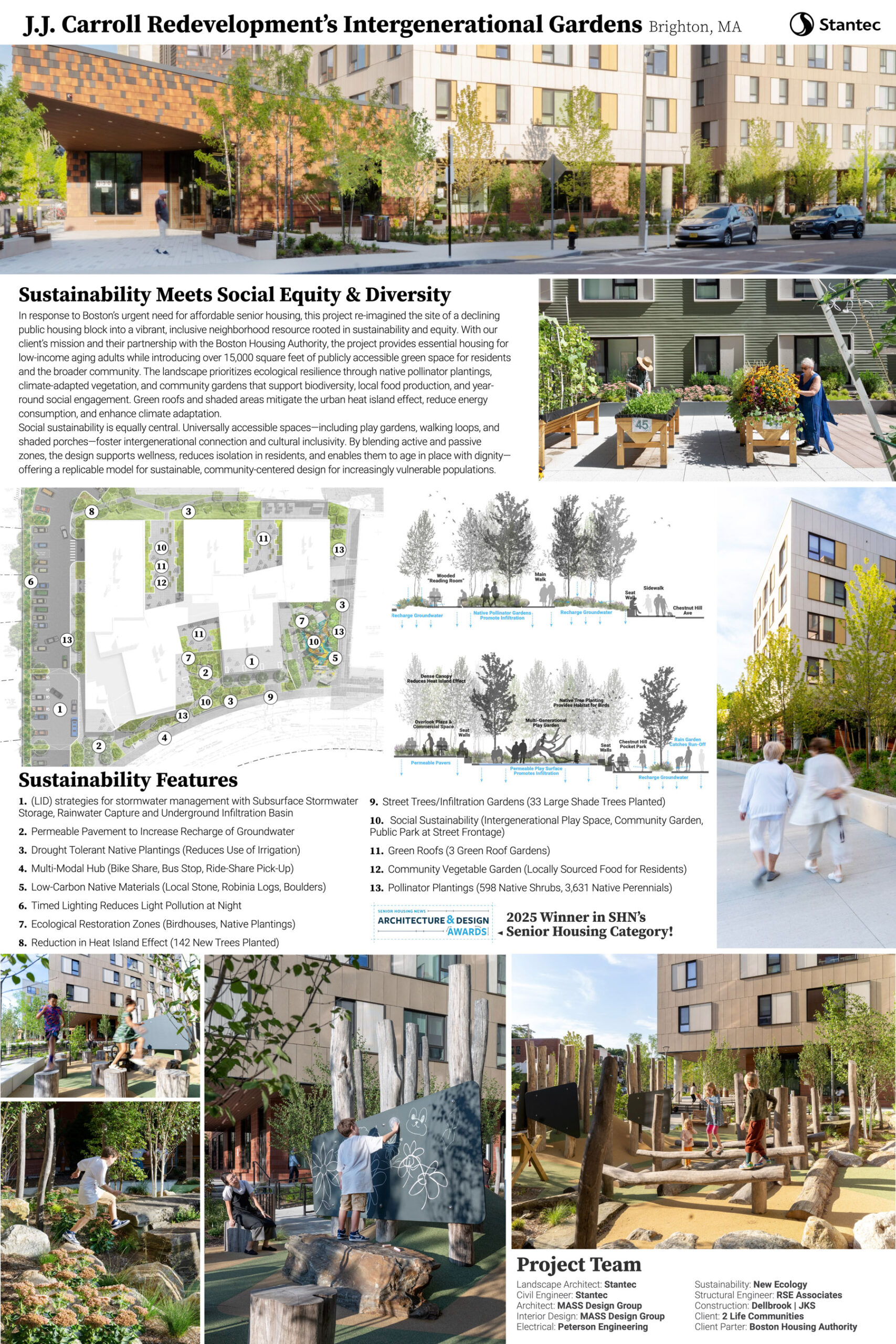
The J.J. Carroll Redevelopment’s Intergenerational Gardens break new ground by integrating native pollinator landscapes with intergenerational landscape design tailored for seniors. The approach redefines how sustainability and accessibility inspire a sense of community in low-income aging adults, improving their mental well-being and sense of place in their home. The project re-imagined the site of a declining public housing block into a vibrant, inclusive neighborhood resource rooted in sustainability and equity.
The landscape prioritizes ecological resilience through native pollinator plantings, climate-adapted vegetation, and community gardens that support biodiversity, local food production, and year-round social engagement. Green roofs and shaded areas mitigate the urban heat island effect, reduce energy consumption, and enhance climate adaptation. Universally accessible spaces—including play gardens, walking loops, and shaded porches—foster intergenerational connection and cultural inclusivity. By blending active and passive zones, the design supports wellness, reduces isolation in residents, and enables them to age in place with dignity.
By merging ecological function with inclusive social design, this project challenges conventional landscape norms. It demonstrates how public green spaces can be regenerative, educational, and deeply human-centered. This is not just a garden—it’s a model for sustainable, intergenerational placemaking in the urban age.
According to the judges, “This project did a beautiful job taking an underutilized site and energizing it with an ecologically restorative and intergenerationally social solution that invites young and old outside to play.”
SUSTAINABLE BUILDING OPERATIONS
Jaycee Place
Submitted by Aspen Air Duct
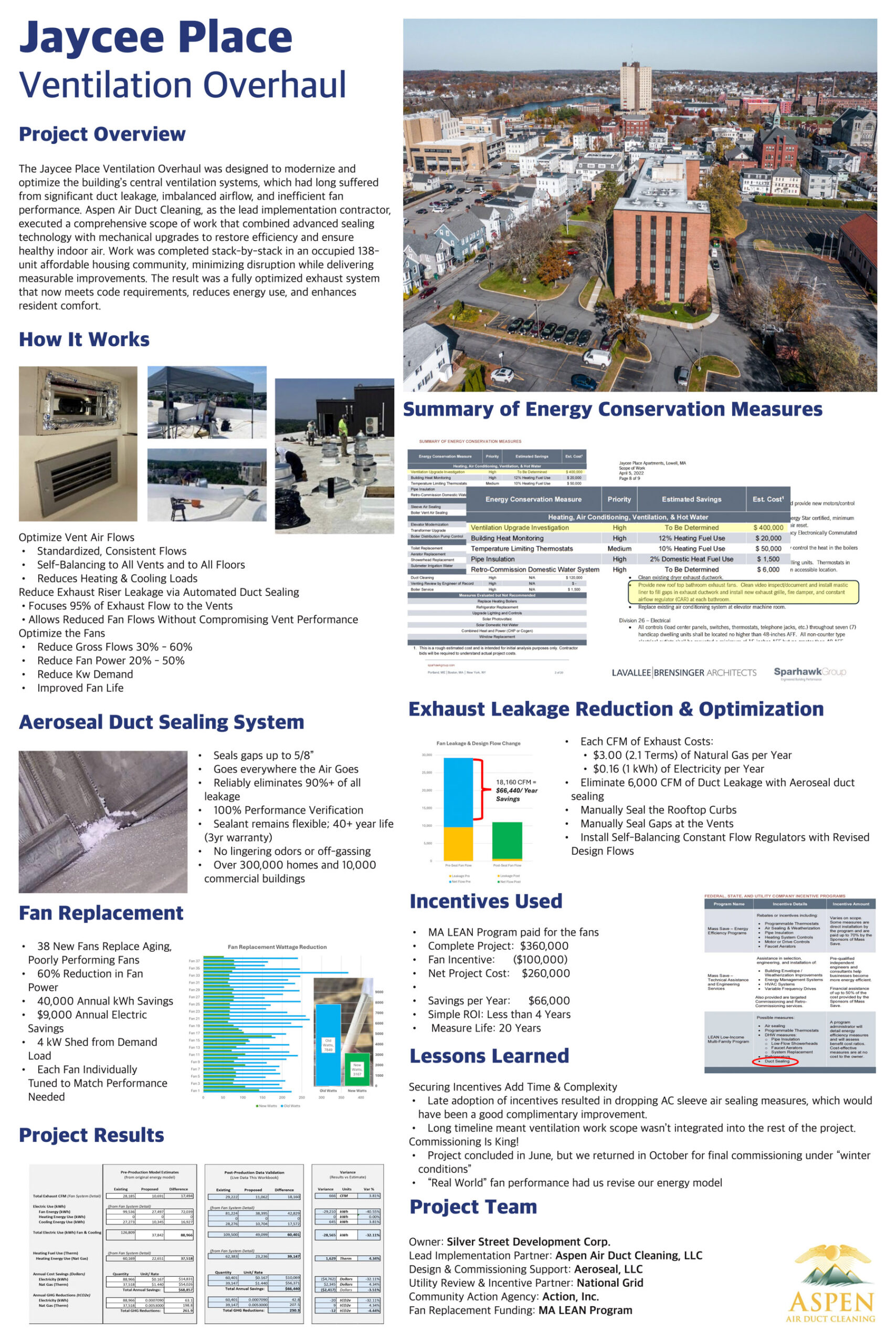
The Jaycee Place Ventilation Overhaul introduced a highly innovative approach by pairing Aeroseal’s patented duct sealing technology with smart fan optimization in the occupied 138-unit affordable housing complex, Jaycee Place. Unlike traditional manual methods, Aeroseal sealed hidden leaks from the inside, cutting duct leakage by 89% with real-time verification. Aspen Air Duct Cleaning then installed and tuned speed-modulating fans and self-balancing dampers, reducing fan energy use by nearly 60% while maintaining code-compliant ventilation. Working floor-by-floor, Aspen minimized disruption to residents while delivering measurable improvements.
The combined impact equals over $66,000 in annual utility cost savings and approximately 262 metric tons of CO₂e reduced each year.
Aspen’s field leadership translated design goals into real, verifiable results, providing healthier indoor air quality for residents while achieving significant energy and carbon reductions. This project demonstrates how advanced technology, when expertly delivered in occupied housing, can achieve deep decarbonization, healthier indoor air, and a replicable model for multifamily retrofits.
According to the judges, “This highly replicable project is a superb example of how high impact, low-hanging fruit projects can yield real, tangible ROIs for environmental performance, human health, and operational cost savings while maintaining continuity in building operations.”
SUSTAINABLE WHOLE-BUILDING RENOVATION
40 Thorndike
Submitted by Elkus Manfredi Architects
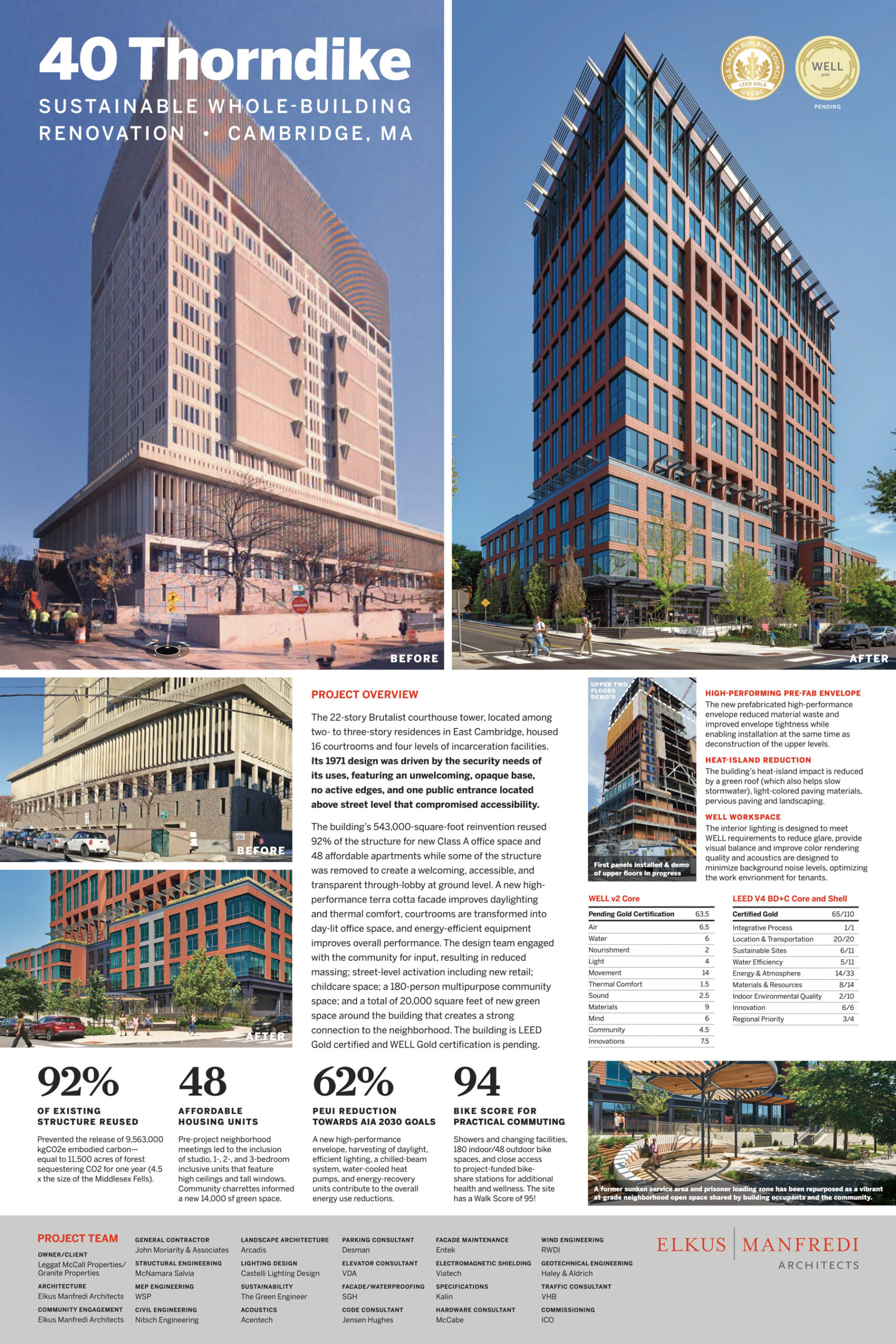
Originally built as a courthouse/jail the major focus of its design was security. Opaque and unwelcoming, with no active edges and only one entrance for the public accessed up a flight of stairs from the street level, 40 Thurndike created a physical barrier in the heart of the community. Courtrooms, some double-height, were stacked on top of each other with the jail located on the top four levels and featured narrow window slots for security.
The design of the building’s adaptive reuse reimagined the existing structure with a new mix of uses that contribute to its neighborhood. The team engaged with the community throughout the project, and all major design decisions were made with community input.
Programming publicly accessible, amenity-rich spaces at ground level creates mutual benefits for both building tenants and the surrounding community. These active spaces foster daily interaction, support a sense of pride and ownership, and enhance safety through consistent use and engagement. By encouraging connection between residents, workers, and neighbors, they help cultivate a culturally rich, vibrant environment that strengthens community ties while adding value to the building itself.
Now a sustainable mixed-use office, residential, and retail destination, the the reimagined 40 Thorndike building has achieved LEED Gold certification. The project represents the rebirth of a deeply difficult and challenging structure that has been transformed by a decade of architectural planning, design, and construction and now takes its place as a good neighbor contributing to the community for the benefit of all.
According to the judges, “This project reinvention is a massive transformation from a brutalist courthouse to affordable apartments and office space. The team’s out-of-the-box thinking created an unexpected community asset that values occupant wellbeing as well as positive climate impact. While the specific situation may not be common, the creativity of the reinvention and the holistic benefits achieved would benefit any renovation.”
SUSTAINABLE CONSTRUCTION INNOVATION
Stellata
Submitted by Stantec
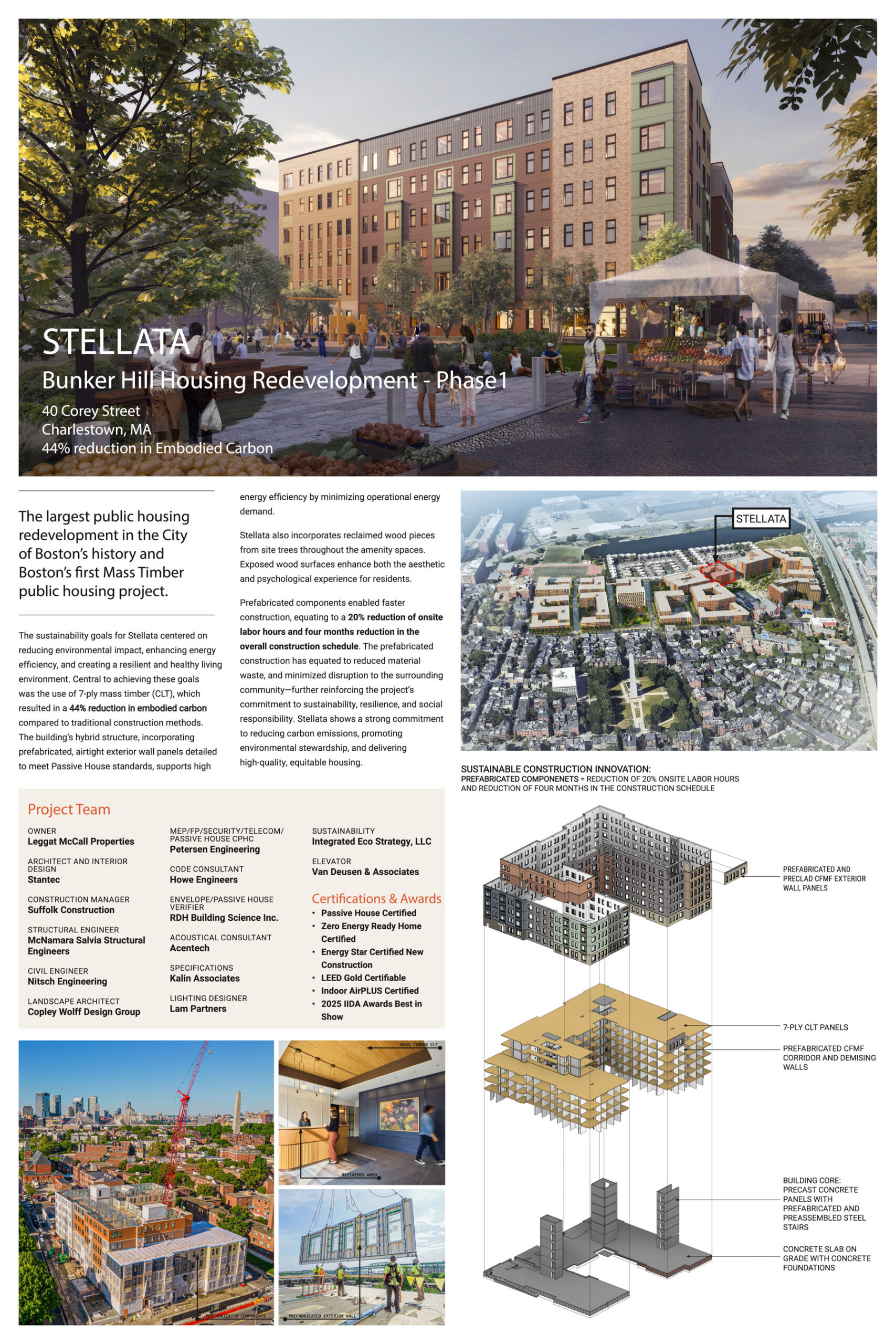
Achieving Passive House Certification, Stellata features several innovative aspects, particularly in its use of prefabricated components and mass timber. Stellata is a six-story building that houses 102 public housing rental units, and is the first of the 14 future buildings that will complete the Bunker Hill Housing Redevelopment. The project is more than just a new building—it is an essential piece of Boston’s 2030 Housing Plan, and a pivotal effort to provide inclusive, affordable housing for all residents.
Stellata utilizes prefabricated and preclad exterior wall panels, which are detailed to meet Passive House standards, ensuring superior energy efficiency. By incorporating mass timber elements, particularly the 62-foot-long 7-ply CLT panels, the project challenges traditional building practices in urban affordable housing. The use of wood in this context not only enhances sustainability but also supports faster construction timelines and reduced labor requirements, making it a cost-effective solution for future developments.
Stellata’s design, with its prefabricated components and Passive House standards, sets a replicable model for affordable housing projects across the region and beyond. Its ability to integrate wood in both structural and aesthetic ways—while meeting the needs of a diverse community—demonstrates how mass timber can be leveraged in non-traditional building types, making it a viable, scalable option for high-performance housing at a larger scale. This project is paving the way for future affordable housing developments that prioritize sustainability, efficiency, and scalability.
According to the judges, “Utilizing a prefabrication process for mass timber construction, the Stellata team married two methods that provide sustainability benefits in their own right. This combination realized reduced construction time, waste and site emissions whilst providing Passive House–level envelope performance that will ensure reduced impact in operations. The project team further leveraged the solution by optimizing floor heights and creating column-free interiors to reduce production waste and provide flexibility for the lifetime of the structure.”
SUSTAINABLE INTERIOR FIT-OUT
Office Deconstruction & Reuse
Submitted by Turner
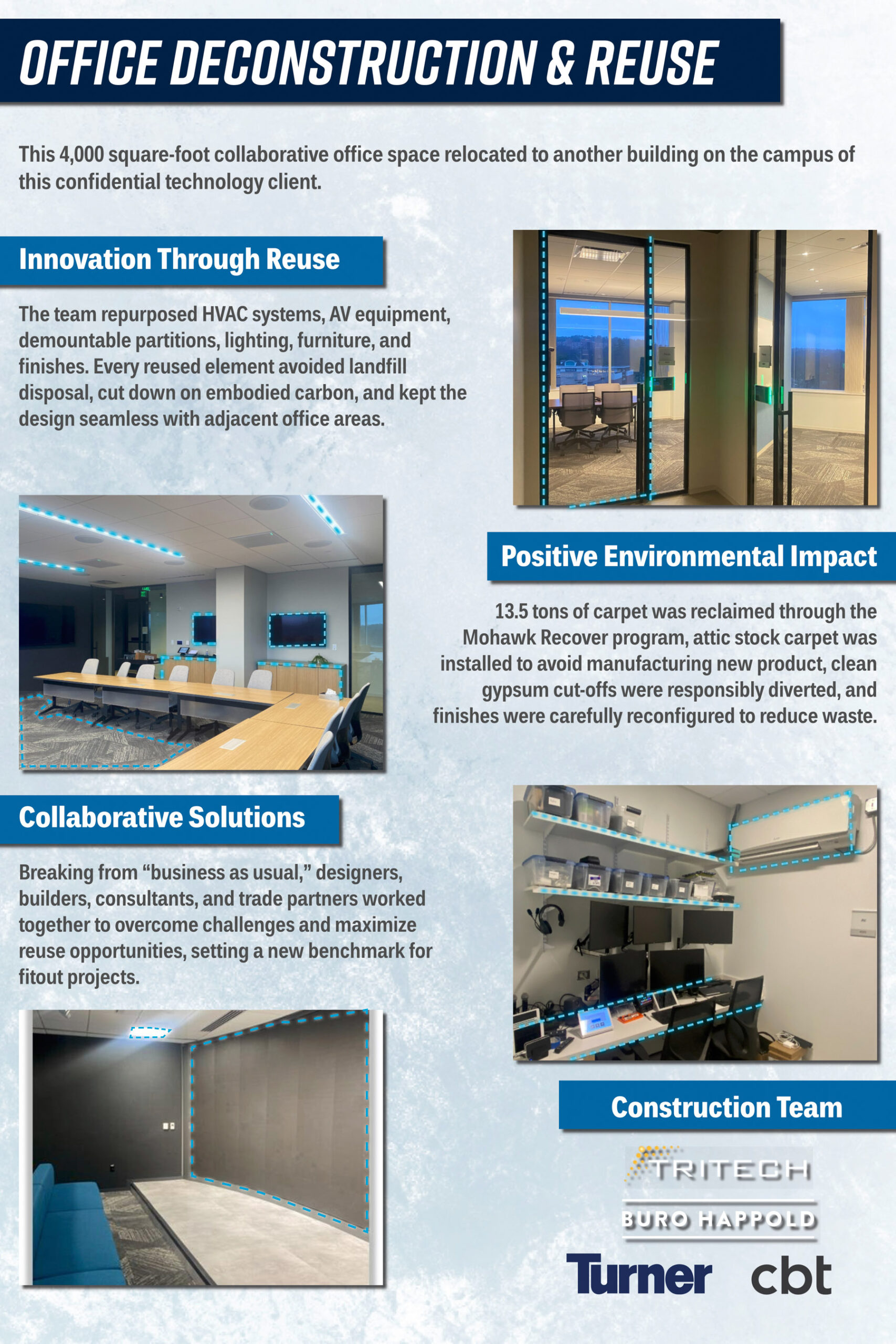
This project for a confidential global technology client in the metro Boston area included the relocation and consolidation of a collaborative office to a 4,000 SF space within another building on a campus. The relocation included an AI theatre, large conference room, project team and huddle rooms, and lounge. The client was motivated to repurpose some of the materials and equipment in the new space. Working collaboratively with the design team, the construction and trade partners found ways to exceed reuse expectations. The design included the relocation of existing furniture, demountable partitions, casework, light fixtures, AV equipment, and HVAC units. The team furnished all carpet within the space from existing attic stock and returned existing to the manufacturer via take-back program.
Commercial construction, compared to the residential sector, is lagging its adoption of deconstruction and reuse. This successful project has created new allies driving circular strategies while realizing the co-benefits of schedule, cost, flexibility, and timely turnover.
Our intent is that more projects exercise the existing avenues of deconstruction, reuse, manufacturer takeback, recycling and donation while also piloting new methods to divert materials. Market transformation requires a culture shift by all involved; clients, designers and contractors. This project should be an example of what is possible when open minds are willing to think creatively so that these practices become more common.
According to the judges, “The winning project redefines sustainable design by fully embracing deconstruction and material re-use, achieving a balance between aesthetics and carbon reduction. Through a holistic approach that extends beyond finishes to include equipment and system components, it sets a replicable model for intentional low-carbon interiors.”
STUDENT PROJECT OF THE YEAR
Terra Cura Center
Submitted by Elijah Feliz, Júlia De Lima, Hunter Osborne, Berlens Badin
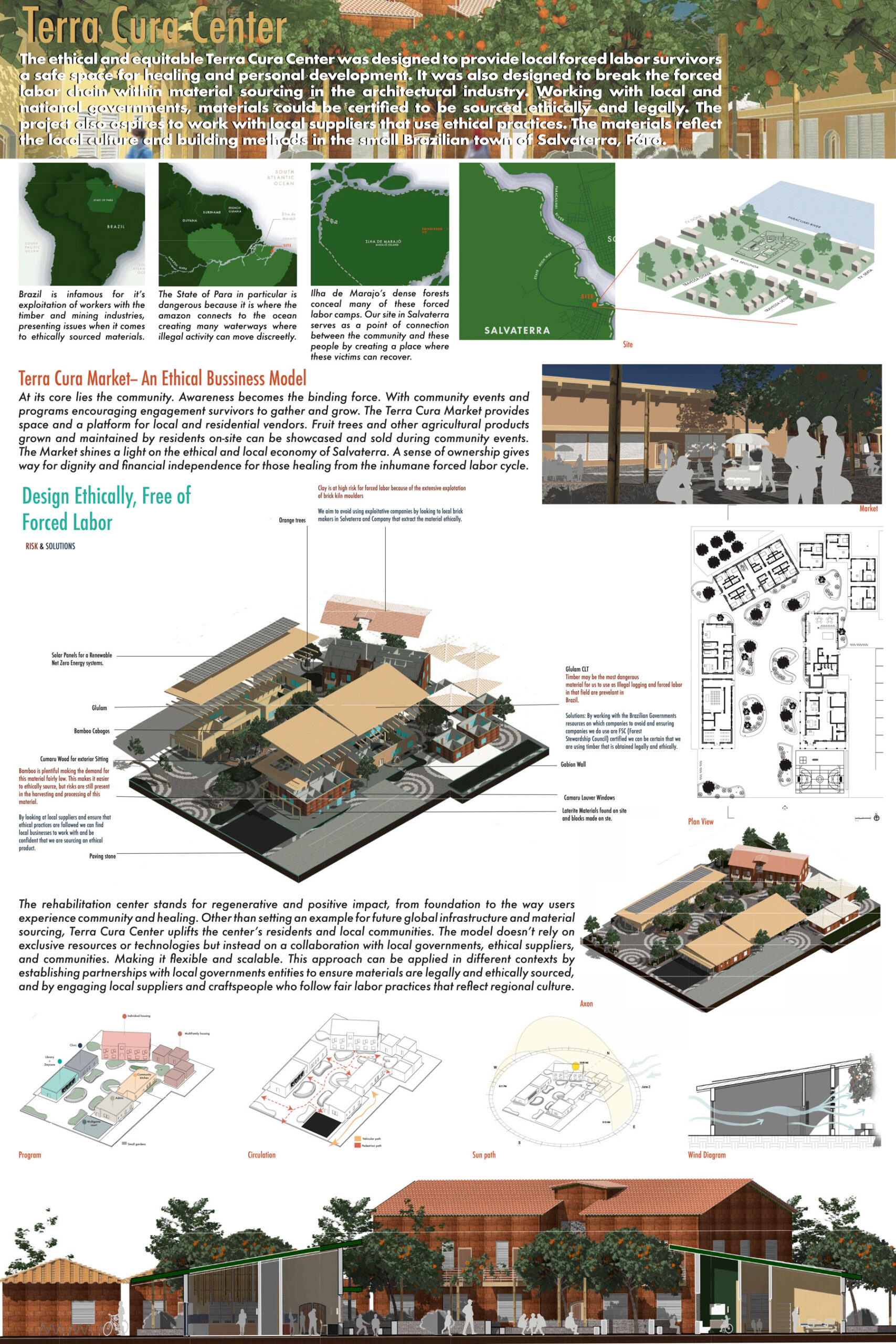
The ethical and equitable Terra Cura Center was designed to provide local forced labor survivors a safe space for healing and personal development, and to break the forced labor chain within material sourcing in the architectural industry. Working with local and national governments, materials could be certified to be sourced ethically and legally. The project also aspires to work with local suppliers that use ethical practices. The materials reflect the local culture and building methods in the small Brazilian town of Salvaterra, Pára.
The rehabilitation center stands for regenerative and positive impact, from foundation to the way users experience community and healing. Other than setting an example for future global infrastructure and material sourcing, Terra Cura Center uplifts the center’s residents and local communities. The Terra Cura Market provides space and a platform for local and residential vendors. Fruit trees and other agricultural goods grown on site and cared after by residents can be displayed and sold in community events. The Market shines a light on the ethical and local economy of Salvaterra. A sense of ownership gives way for dignity and financial independence for those healing from the inhumane forced labor cycle.
The model doesn’t rely on exclusive resources or technologies but instead on a collaboration with local governments, ethical suppliers, and communities, making it flexible and scalable. This approach can be applied in different contexts by establishing partnerships with local government entities to ensure materials are legally and ethically sourced, and by engaging local suppliers and craftspeople who follow fair labor practices that reflect regional culture.
According to the judges, “The Terra Cura Center was selected as the winner for its holistic and innovative approach to addressing both environmental and social challenges, creating a replicable model that promotes ethical material sourcing, economic empowerment, and community healing while setting a new standard for how design can advance equity, sustainability, and local resilience.”
A note from the judges:
“And an honorable mention to all of the teams that entered their projects in this category. We wanted to recognize the Slow Fashion project submitted by Abby Borges and Angela Lang from Wentworth whose thoughtful and detailed research resulted in a fashion and textiles school design that leveraged several sustainable strategies to connect students and the local community with existing and new buildings through the use of bio-based and recycled materials.”
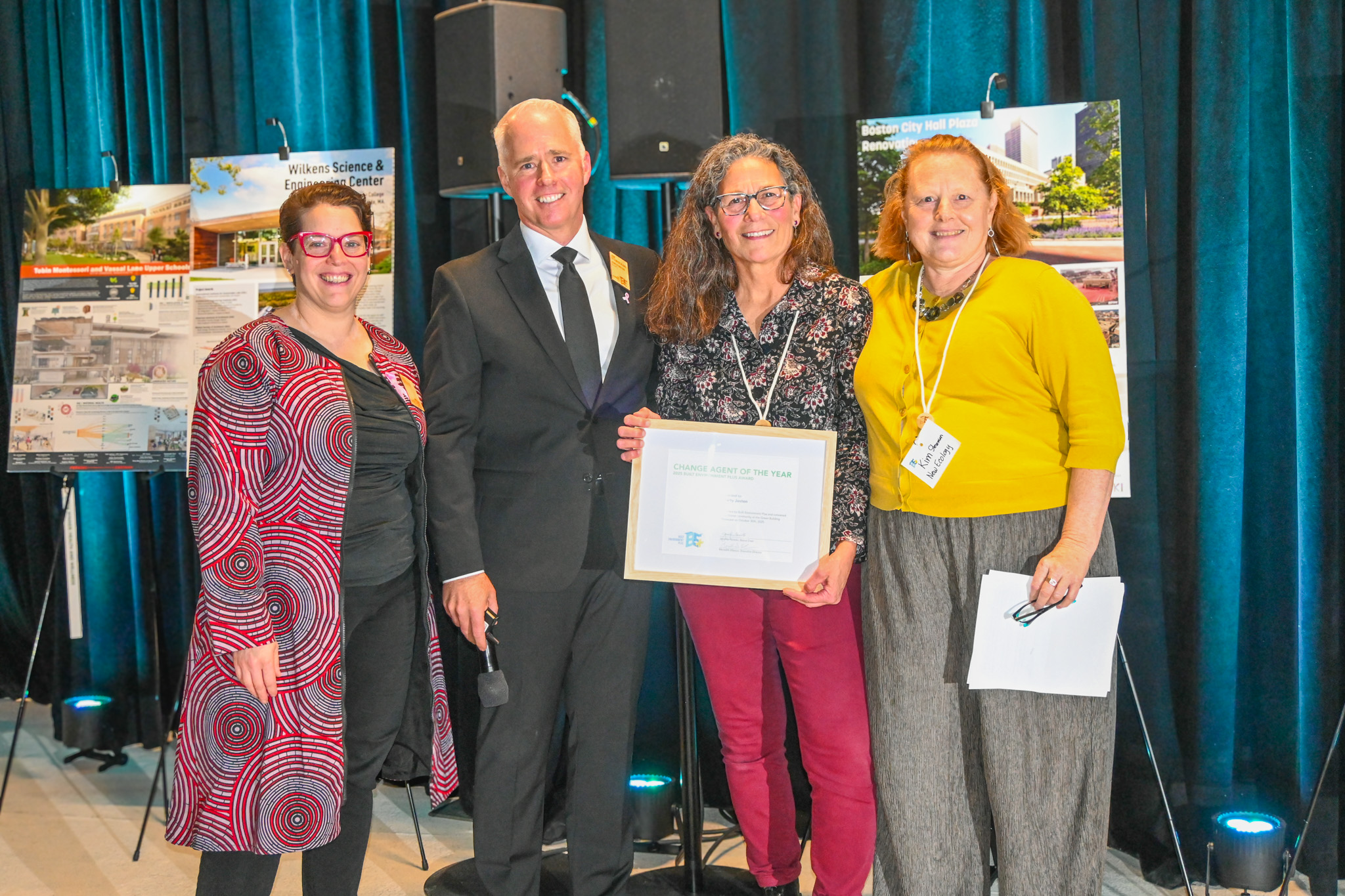
CHANGE AGENT OF THE YEAR
Marty Josten
Congratulations to Marty Josten, Principal Director of Building Decarbonization at New Ecology.
“Marty’s impact goes far beyond technical expertise, she’s not only advancing building decarbonization, she’s creating a blueprint for how communities can build a resilient sustainable future through collaboration which is so critical for this work…Marty combines rigorous technical insight with deep belief in people. She’s deeply committed to helping environmental justice communities thrive by building one family at a time,” says her nominator, Joyce Losick-Yang.
“Marty leads nationally impactful initiatives that drive climate and economic benefits at scale. Her leadership is rooted in deep technical expertise and a collaborative ethos, working closely with community and external partners to deliver engineering audits, analysis, and scoping services that transform individual properties and entire portfolios… Marty’s professional accomplishments are grounded in a simple and profoundly powerful kindness and compassion for others (along with a wicked sense of humor) that engenders lifelong friendships and encourages the professional development of her peers.”
Green Building Showcase 2025 Digital Gallery
MAJOR THANKS TO OUR AWESOME JUDGES!

Allison Wilson
Ayers Saint Gross

Angi Rivera
Sellen Construction

Brian Turner
CMTA

Cedra Goldman
The Manya Group
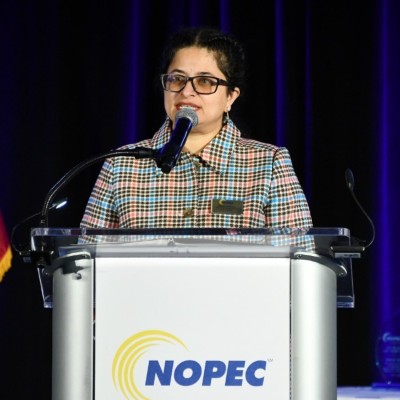
Deepa Vedavyas
NOPEC

Karina Hershberg
PAE Consulting Engineers

Kjell Anderson
LMN Architects

Lona Rerick
ZGF Architects

Margaret Montgomery
NBBJ

Maria Perez
Gensler

Michael Brown
HKS

Prairna Gupta-Garg
WRNS Studio

Rob Winstead
VMDO Architects

Sandra Montalbo
Overland Partners

Teresa Rainey
Interface Engineering